Posts tonen met het label NATO. Alle posts tonen

donderdag 9 april 2015

NATO tests 'Spearhead Force' alert procedures

EINDHOVEN, The Netherlands -  NATO assessed its alert procedures for the Very High Readiness Joint Task Force (VJTF) for the first time during Exercise NOBLE JUMP from 7-9 April 2015, involving over 1,500 personnel from 11 Allied nations.  Germany, Poland, Norway, Denmark, Hungary, Lithuania, Croatia, Portugal, and Slovenia tested their Headquarters’ response to alert procedures and high-readiness units from The Netherlands and Czech Republic physically deployed equipment and troops to airports and railheads.

This activity represents an important milestone as NATO continues to respond to emerging security challenges.  The exercise has its origins in last year’s Wales Summit, where NATO leaders collectively agreed to establish the VJTF, or what some call the ‘NATO Spearhead’ force.  These developments are part of wider enhancements to the NATO Response Force in order to address instability on NATO’s southern and eastern flanks.


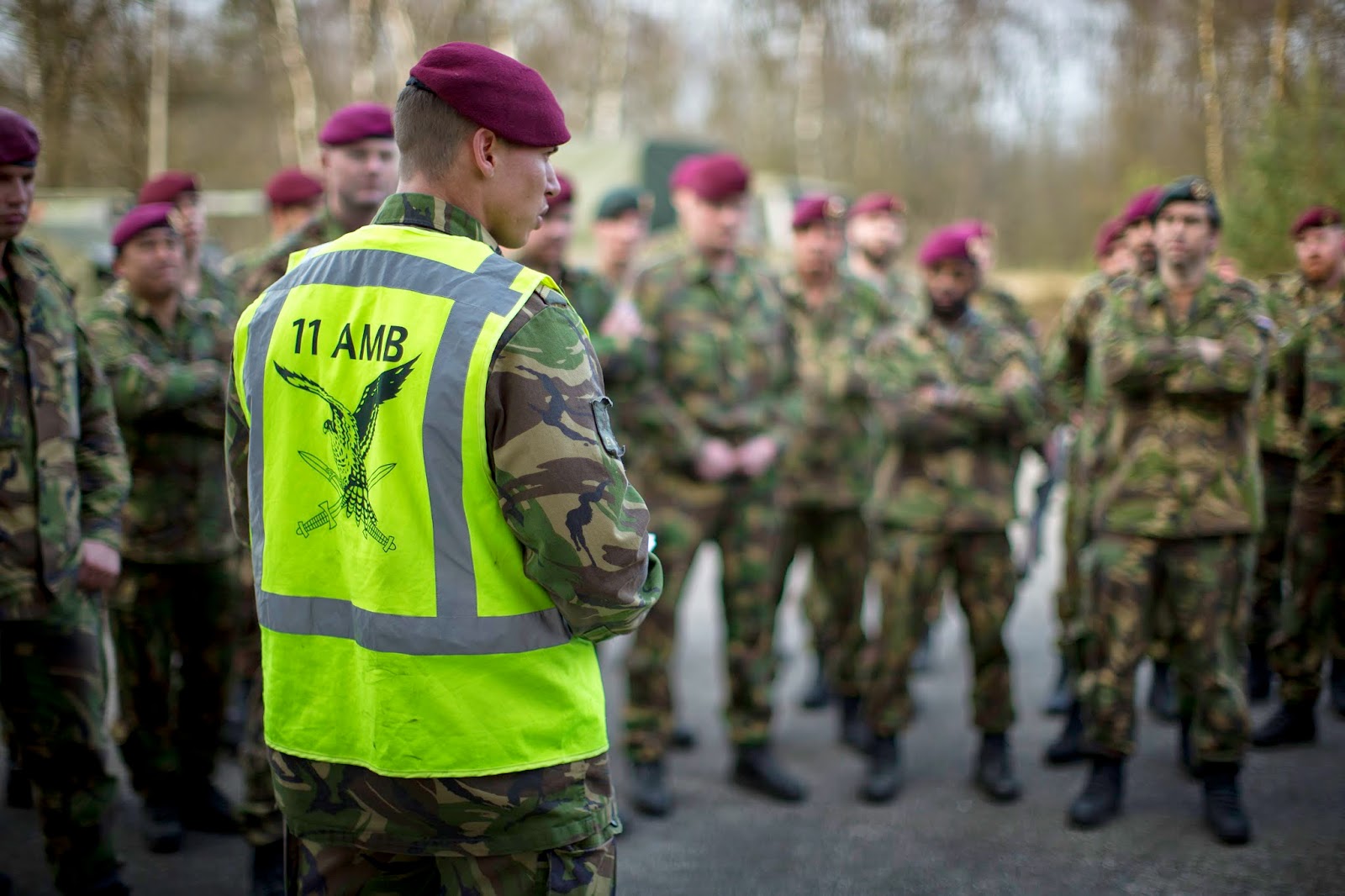
Soldiers of 11 (NLD) Air Manoeuvre Brigade involved in the exercise

"NATO military planners have been working tirelessly to enhance NATO’s Response Force and implement the Very High Readiness Joint Task Force, and today our progress is manifested in the rapid deployments we see happening in locations across the Alliance,” said General Philip Breedlove, Supreme Allied Commander Europe (SACEUR).  "These measures are defensive, but are a clear indication that our Alliance has the capability and will to respond to emerging security challenges on our southern and eastern flanks,” he said.

For the last several months, NATO has been developing the concepts behind the VJTF and established an interim force early in 2015.  Exercise NOBLE JUMP marks the first time that high-readiness units have physically tested their response to rapid ‘orders to move’ under the new VJTF framework.  The training event marks a learning process that will allow NATO military staff to identify both successes and shortfalls as the Alliance continues to refine its high readiness capabilities.

Czech and Dutch High-Readiness Troops Put to the Test
 In the afternoon of 7 April, the 11th Air Mobile Brigade in The Netherlands and the 4th Rapid Reaction Brigade in the Czech Republic were given orders to rapidly prepare to deploy their troops and equipment.

"In the hours that ensued, Dutch and Czech formations recalled their military personnel to base, conducted hasty movement planning, briefed personnel, prepared and verified equipment, weapons, supplies, and vehicles,” said Colonel Mariusz Lewicki, the head military planner for the VJTF at SHAPE.  "The lead troops were able to move in under eight hours, with all elements moving in under 48 hours, so our initial impression is we are very pleased with the results,” he added.

The Commander of the Dutch 11th Air Mobile Brigade, Brigadier-General Kees Matthijssen, also felt that Exercise NOBLE JUMP achieved its aims.

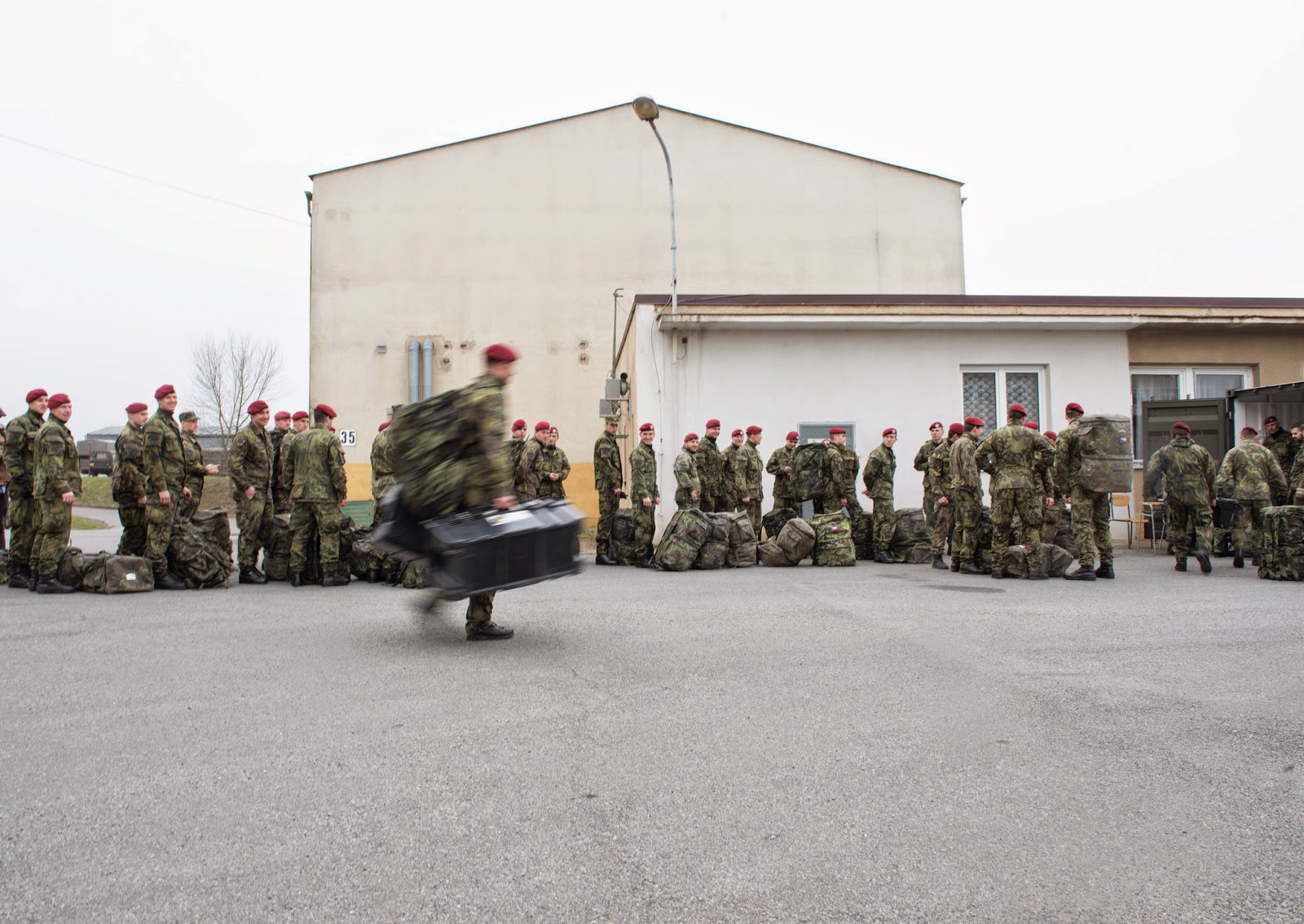
Czech paratroopers participating in EX NOBLE JUMP

 "So far we are satisfied, our men and women responded well to the alerting and we managed to send off the first troops as scheduled. We are sure that we will be able to meet our goals, which were to move all troops and equipment within 48 hours,” said Brigadier-General Matthijssen.  "Of course, we have noted some things to improve during the exercise, but this will definitely lead to further refinement and improvements of our high readiness plans,” he said.

A total of 900 German soldiers were also recalled to their units in Marienberg, Gotha, Idaroberstein and Bad Salzungen during Exercise NOBLE JUMP.  These troops conducted similar planning and alert verifications in their respective garrisons.

The overall aim of Exercise NOBLE JUMP was to improve and refine alert and deployment procedures for the VJTF.  In the coming weeks NATO military staff will conduct an analysis of the results from this exercise and Allied units will refine their tactical procedures.  Lessons will be shared and NATO will continue to refine the overall alert and deployment process, and ensure it is integrated in overall plans for the NATO Response Force.

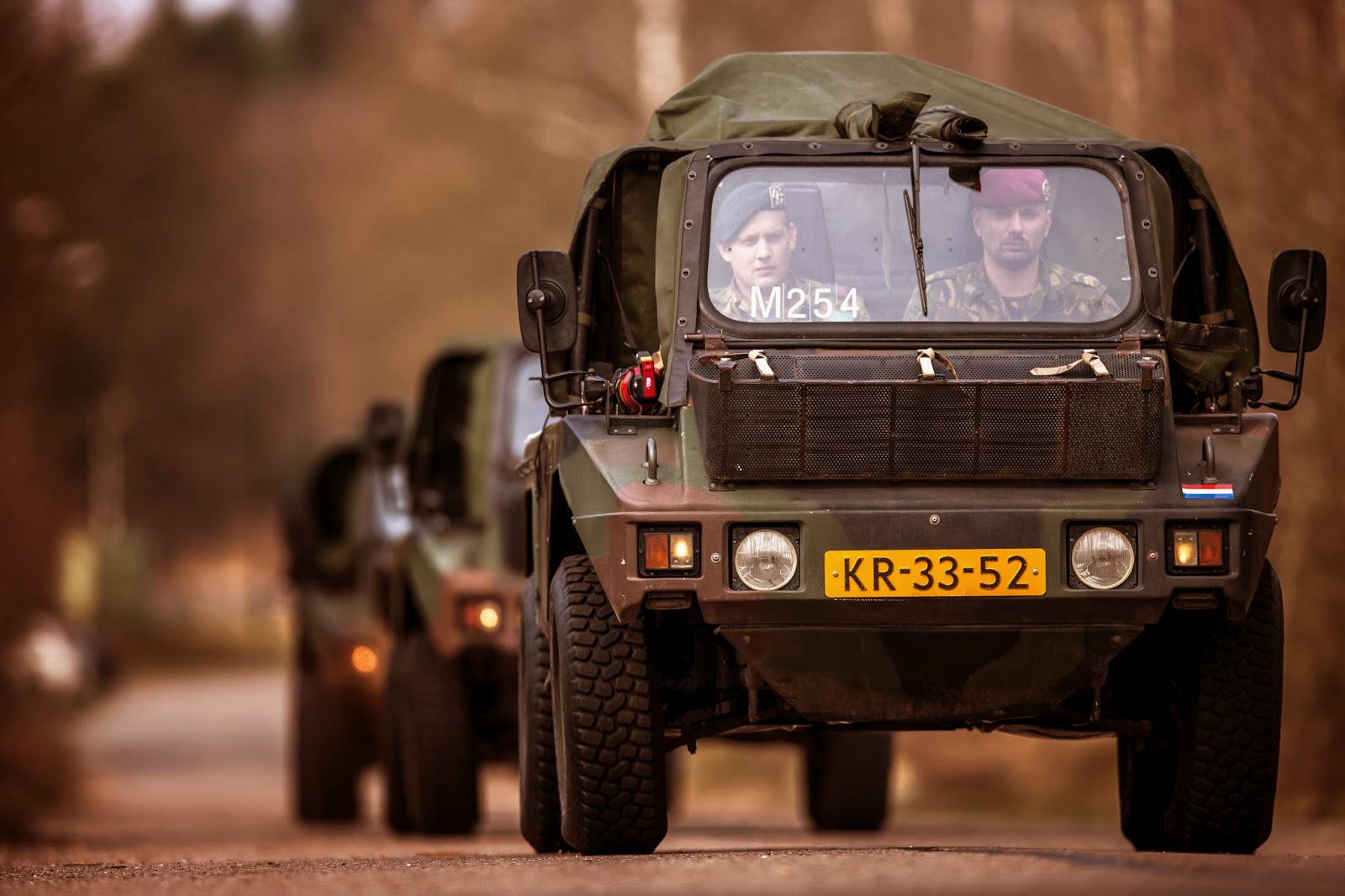
11 (NLD) Air Manoeuvre Brigade troops on the move

"Moving military units at short notice is a highly complex process that requires careful planning and constant refinement and practice to maintain capability,” said Colonel Lewicki.  "We’ve had a very good start this week, but much work remains and we will continue exercising these concepts throughout 2015 and 2016,” he said.

Increasingly complex exercises, trials, and evaluations will be conducted in order to develop, refine and implement the VJTF concept into the framework of the Readiness Action Plan and the NATO Response Force.  Examples of future training activity include part two of Exercise NOBLE JUMP, 9-20 June 2015, where units assigned to the VJTF will deploy to the Zagan Military Training Area in Western Poland, as well as Exercise TRIDENT JUNCTURE 2015 in Italy, Spain and Portugal from 21 Oct – 6 Nov 2015.

SHAPE Public Affairs Office

woensdag 1 april 2015

Oefening VJTF: NOBLE JUMP

(Eerste oefening van de VJTF, de nieuwe 'flitsmacht' van de NATO Response Force. Onderdelen vinden plaats op luchtmachtbasis Eindhoven en in Chrudim in de Tsjechische Republiek)

NATO VJTF (Spearhead) Deployment Exercise

NATO will commence the process of testing and refinement of the Very High Readiness Joint Task Force (VJTF) during part one of Exercise NOBLE JUMP, being held from 1-10 April 2015.

The VJTF is being established as a part of an overall enhancement to the NATO Response Force in order to address new security challenges on NATO’s southern and eastern peripheries.

The NOBLE JUMP ‘Alert Exercise’ being conducted in early April is the first time that high-readiness units will practice responding to rapid ‘orders to move’ under the new VJTF framework.  As such, this event represents a learning process that will allow NATO military staff to identify both successes and shortfalls during the early stages of the development process.

Increasingly complex exercises, trials, and evaluations will be conducted throughout 2015 and 2016 in order to develop, refine and implement the VJTF concept into the framework of the NATO Response Force.

Examples of future training activity include part two of Exercise NOBLE JUMP from 9-20 June 2015, where units assigned to the VJTF will deploy to the Zagan Military Training Area in Western Poland, as well as Exercise TRIDENT JUNCTURE 2015 in Italy, Spain and Portugal from 21 Oct – 6 Nov 2015.

(Source: ACO/NATO)

woensdag 3 december 2014

NATO foreign ministers on the Readiness Action Plan

Statement of Foreign Ministers on the Readiness Action Plan

02 Dec. 2014

Allied Foreign Ministers met to review implementation of the Readiness Action Plan. This has been the first high-level political meeting after the Wales Summit. We welcome progress achieved in delivering on the decisions taken by our Heads of State and Government.

The Readiness Action Plan agreed by Heads of State and Government at the Wales Summit is a response to the changed and broader security environment in and near Europe. It responds to the challenges posed by Russia and their strategic implications. It also responds to the risks and threats emanating from our southern neighbourhood, the Middle East and North Africa. Its implementation will significantly enhance NATO’s readiness and responsiveness and will contribute to ensuring that NATO forces remain ready and able to respond swiftly and firmly to current and future challenges to the Alliance. It will strengthen both NATO’s collective defence and crisis management capability.

Implementation of the Plan is well underway. Today, we reiterate the commitment of our nations to ensuring that NATO remains a strong, ready, robust and responsive Alliance. There is already an increased presence of NATO maritime, land and air forces and meaningful military activity in the eastern part of Alliance territory. All Allies are contributing to this defensive effort and they will continuously rotate air, maritime and land forces in the region and conduct additional exercises, 28 for 28, through 2015. This provides the fundamental baseline requirement for assurance and deterrence. These forces are effectively responding to increased Russian military activity, including through monitoring Russian military flights and maintaining the integrity and safety of our airspace.

At the same time, we are enhancing the NATO Response Force’s capabilities, including through the development of a new Very High Readiness Joint Task Force, the VJTF. We welcome the establishment of an interim VJTF coordinated by SACEUR with forces predominantly from Germany, Norway and the Netherlands, available to the Alliance early in 2015.

Work on the other measures envisaged in the Readiness Action Plan is advancing rapidly, including on the establishment of an appropriate multinational command and control presence on the territories of the Eastern Allies. NATO Defence Ministers will further assess progress and take decisions, when they meet in February 2015, on enhancing the Alliance’s readiness and responsiveness as part of the adaptation of NATO to the changed security environment, in line with the decisions taken at the Wales Summit.

(NATO)

dinsdag 25 november 2014

Speech by Prime Minister Mark Rutte at the NATO Parliamentary Assembly Annual Session

Speech by Prime Minister Mark Rutte at the NATO Parliamentary Assembly Annual Session, The Hague, 24 November 2014.

Ladies and gentlemen,

It is an honour to speak to you here in my home city at the 60th Annual Session of the NATO Parliamentary Assembly. I hope that over the past few days we’ve shown how much we appreciate your coming to our country.

I would like to extend a special welcome to Secretary-General Jens Stoltenberg. Jens, I know you as someone who works hard to build support and get results. You have the ability to strike a balance between consultation and action. So you’re the right man for the job and I look forward to working with you.

Being NATO Secretary-General is, of course, a magnificent job. Even so, the first person to hold the post, Lord Hastings Ismay, had to be talked into accepting it in 1952 by none other than Winston Churchill. As a military man, Ismay was concerned that there would be too much red tape and too little action. But Churchill won him over by saying – and I quote – ‘…that NATO provided the best, if not the only, hope of peace in our time’.

And that’s exactly what NATO has been since it began 65 years ago: our best hope for peace and security. That’s still true today, especially now that Europe is faced with an arc of instability that is much wider than we once thought. Many people are talking of a new reality, of a new north-south divide, even of a new cold war.

And while I don’t think it wise in today’s multipolar world to draw simple historical parallels, one thing is certain: things are happening fast on the eastern and southern edges of NATO’s European territory.  And the changes in geopolitical relations will last for a long time to come.

Think back to last year. Who could have imagined Russia’s aggression in Ukraine? Or such violent Islamic fundamentalism right on NATO’s doorstep? Almost every day, we are confronted with the fact that we cannot take peace and security for granted. The way we live − in democracies governed by the rule of law − is at stake.

NATO has made a substantial contribution to peace, security and prosperity in Europe. For 65 years, it has been a key defender of the norms and values we cherish as Western allies. Outside its own territory, too. Because if we want to protect our freedoms and civil rights we have to go beyond our own borders.

We have to join forces globally, by helping to maintain the international legal order. That’s in our own interests too, of course. By exporting stability, we limit the chances of importing instability. And NATO has a role to play here – along with the UN, the OSCE, the EU and other international organisations. Because global threats demand a global response.

I’m glad that NATO has responded appropriately to Russia’s aggression towards Ukraine and the recent developments in North Africa and the Middle East. For the Netherlands, NATO’s added value is not in question. Quite the opposite. We’ve seen recently, once again, how transatlantic cooperation provides the security guarantees that Europe needs to make it a relatively stable continent. How would countries like Poland and the Baltic States have felt in recent months without that collective security umbrella? Defending NATO’s territory is still the mainstay of our alliance. So it’s good that we re-affirmed this principle in a joint declaration at the recent summit in Wales.

The Netherlands will of course continue its active contribution to NATO’s efforts. That applies not only to Operation Resolute Support in Afghanistan and the immediate assurance measures we decided on earlier this year. It also applies to strategic decisions for the longer term, like investing in cyber security and ballistic missile defence, agreeing on the Readiness Action Plan, and setting up the Very High Readiness Joint Task Force.

Our priorities for the months ahead are clear. It’s also clear that these activities will cost a lot of money. More than is now available, in fact. So it’s good that we decided in Wales to boost our defence spending over the next ten years.

This is necessary, but it imposes a duty on us. A duty to show our taxpayers that their money is being spent smartly and effectively. Not only when it comes to national defence budgets, but NATO’s budget too. NATO is already working to make its financial affairs more transparent. And I sincerely hope that the 28 member countries can make further agreements on this in the future. After all, transparency and public support go hand in hand.

Ladies and gentlemen, as ‘our best hope for peace’, NATO deserves that support. So let’s continue to build on that together. Let’s continue to build on our broad transatlantic security agenda and make ourselves resilient to the threats of today, tomorrow and beyond.

Thank you.

(Source)

maandag 24 november 2014

NATO SG: "Time has come to stop defence cuts"

Keynote address

by NATO Secretary General Jens Stoltenberg at the 60th Plenary Session of the NATO Parliamentary Assembly in The Hague

24 Nov. 2014Mr. President,

Distinguished members of parliament,

Ladies and Gentlemen,

Thank you for that very kind welcome.  It is a pleasure to be here at the NATO Parliamentary Assembly.  For more than 20 years, I was elected to serve my constituents as a proud member of the Norwegian Parliament until I became Secretary General of NATO.

That experience taught me the true value of Parliaments.  To hold governments to account.  Ensure that tax payers’ money is well  spent.  And that the views of the people  are heard.  

This is my first opportunity to speak with you.  But it will not be my last.  I intend to meet with you regularly.  To consult with you and seek your ideas. This is important to me.

Today, NATO needs your support more than ever.

We are working hard to turn the decisions we took at the Wales Summit into reality.

On my first day in office, I outlined my three priorities.

To keep NATO strong as a political and a military Alliance.

To work with our partners to bring more stability to our neighbourhood.

And  to keep the bond between Europe and North America rock-solid.

Each of these priorities requires financial resources, underpinned by political will.

But without them, there can be no security. And without security there can be little else.  No safety.  No prosperity.  No freedom.

The link you provide to our parliaments and our citizens is vital for NATO.  This is why today I would like to discuss with you core issue: keeping the defence pledge that we made at the Wales Summit.  

With the end of the Cold War, the world changed. And defence budgets were cut.  As people – rightly – demanded a peace dividend.  With no imminent territorial threat, this made sense.  Later, with the financial crisis, the cuts became even deeper.  

We have gone from standing armies to smaller, deployable forces.  From a NATO command structure of 22,000 to less than 9,000.  And from over 33,000 tanks, to less than 7,000.

We have also postponed new investments. Reduced our exercises. And cut back on the maintenance of equipment.

I’m not arguing that we need to return to where we were. And have exactly the same forces, capabilities and structures.

But  once more, our world has changed.

To our East, Russia is trying to replace the rule of law with the rule of force.

To our South, we also see the terrible human cost of conflict. We see violence and extremism across North Africa and the Middle East.  And we continue to face many other challenges – from missile proliferation to cyber attacks.

We must face up to these changes.  We must have more and better equipped armed forces.  We must have the right balance of forces and capabilities.

Let me be clear. This is not just an exercise in accountancy. The stakes are high. The  threats are real.

So we must redouble our efforts to resource our Alliance.

The Readiness Action Plan we adopted at the Wales Summit is the most significant strengthening of our collective defence.  It will help us deal with threats from wherever they come.

From the east or the south.

So it is vital that we implement the plan on time and in full.

A key part of it is the new ‘Spearhead Force’.  A very high readiness force able to react quickly.  With a command and control presence in the Eastern part of our Alliance.    And a demanding new exercise programme.   So we can have the right forces, in the right place, at the right time.

At Wales, we also decided to launch a new mission in Afghanistan. To train, advise and assist the Afghan Security Forces from January.

And we also decided to increase our support for  our partners, such as Iraq, to build their own defence capacity if they request it.  And project stability in our neighbourhood.

All these efforts  must  be properly resourced.

And our military needs long term investment and political support.  For readiness comes at a cost.

If we look around the world, while NATO has cut defence spending, others have rapidly increased it.  Over the last 5 years, Russia increased its spending by fifty percent.   And it plans further increases.

At the same time, total NATO defence spending fell by twenty percent.  And some nations are cutting further.

In more peaceful times, it was right to reduce defence spending.   But we do not live in peaceful times. So it is right to stop the cuts and to increase investment in our defence.

This is not  just about  NATO in comparison to the rest of the world.  It is also about the balance within NATO. And within Europe.

All Allies are expected to shoulder their fair share of the burden. In terms of spending, in terms of capabilities, and in terms of contributing to our operations.

The GDP of the United States and that of Europe is almost exactly the same.  Yet the United States spends more than twice as much on defence than all the other Allies combined. Providing over two thirds of total defence spending by NATO Allies.

For all these reasons, at our Wales Summit, we agreed to invest in our collective defence.  And to have a more balanced sharing of costs and responsibilities.  We made a joint pledge:

To stop the cuts

To increase spending in real terms as our economies improve

To aim to spend 2% of GDP on defence within a decade

To spend better

And to deliver the capabilities we need.

We also agreed that progress will be reviewed annually. We will start at the meeting of defence ministers in June. And we will also place it on the agenda of future summits.

By the Warsaw Summit in 2016, we must show progress.  And a way forward to further improvement in the years ahead.  So we need to make the best of the time we have.

I know that increasing defence spending is not easy.   But it is possible. Step by step. And every step counts. Starting now.

The United States, the United Kingdom, Greece and Estonia are already meeting the 2 % guideline.  And other Allies have outlined their own roadmap to get there.  

Of course, this is not just about how much money we spend on defence. It’s also about what we spend that money on.  And how we spend it.

At Wales, we committed to spending 20% of defence budgets on new equipment, including research and development, within a decade.

We have identified specific areas where we need to improve our capabilities.  Such as ballistic missile defence, training and exercises, and fully equipping our land forces.

We must make progress in all of these areas.  To ensure that our forces remain strong and able to deploy at short notice.

NATO can really add value when it comes to how defence budgets are spent   By helping Allies to align their priorities, to plan together, pool their resources, and get the most for tax-payers money.

There are many examples of how we’re doing just this.

For example, the new system of drones and other capabilities that make up the Alliance Ground Surveillance system.  Operated and maintained by NATO.  Giving our commanders a comprehensive picture of the situation on the ground.

Or the Framework Nations Concept agreed at Wales.  Where groups of European Allies work together to develop particular forces or capabilities, guided by a lead nation.

And here in the Netherlands, we are in a country that is a prime example of regional cooperation.   Dutch armed forces cooperate closely with their counterparts in Belgium, Luxemburg, Germany and the United Kingdom. Naval forces combine with Belgian naval forces under a single Admiral.

Allies gain a great deal from Smart Defence and other types of multinational cooperation.  Getting the most out of every dollar, euro and pound.

But this is not a substitute for more resources. We cannot do more with less indefinitely.  And defence cannot take an excessive share of the austerity burden.

We must be clear with our publics about why we need to increase defence investment.  And we must continue our efforts towards greater transparency.

When it comes to NATO’s own budget, Allies maintain full control over how much and how effectively tax-payers’ money is spent in the interest of our shared security. The budget is rigorously audited by an independent team of auditors. And this independent board regularly reports to the North Atlantic Council.

Allies review all reports. And all unclassified reports are now published on the NATO website. I also intend to continue publishing an annual report on everything that NATO does, including defence spending.  

Ladies and gentlemen,

The time has come to stop defence cuts. We must invest more in defence and spend our money better. And you, the parliamentarians, play a vital role in fulfilling the defence pledge we made at the Wales Summit.

This is first time that heads of state and government have made such a pledge.  And it is a pledge that we must honour.

Defence investment in times of austerity calls for hard choices at home. In every government. And in every parliament.

It is my responsibility to work with you to implement what was decided. And I am personally committed to this.

We all need to work hard. And we will all be judged on the progress we make.

So I need you to make the case at home. To speak up for defence.  To increase the momentum for more defence spending. To reach out across the political spectrum.  And to persuade your constituents of the value of defence investment.

If we fulfil the Defence Pledge that we made at Wales, we will keep ourselves safe.  And, working with others, we will help to keep peace around the world.

So we have much to do together.   And I thank you for your support.

Thank you.

(Source) (audio)

maandag 8 september 2014

NAVO-top: sneller op crises reageren

De NAVO moet veranderen om op nieuwe dreigingen snel een antwoord te hebben. Dat was de slotconclusie van de topconferentie die vreijdag in Newport (Wales) eindigde. De regeringsleiders stelden dat het bondgenootschap sneller in actie moet kunnen komen.

Meer samenwerking was daarbij de boodschap. Tijdens de vergadering bogen de deelnemers zich ook over de ontwikkelingen in Oekraïne, het Midden-Oosten en Noord-Afrika.

Samenwerking Duitsland - Nederland
Minister Jeanine Hennis-Plasschaert en haar Duitse collega Ursula von der Leyen verklaarden de intensieve samenwerking tussen de 2 krijgsmachten nog verder uit te breiden. Deze samenwerking is een voorbeeld van het Framework Nations Concept, dat tijdens de NAVO-top brede steun kreeg. Hierbij werkt een groot land met veel defensiecapaciteiten samen met kleinere landen die over specialistische kennis beschikken.

De verdere integratie van Duitse en Nederlandse eenheden wordt het komende jaar onderzocht. Daarnaast onderzoeken de landen hoe ze nog beter kunnen samenwerken bij het ontwikkelen en bouwen van defensiecapaciteiten. Zoals de verdediging tegen ballistische raketten, onderzeebootbestrijding, samenwerking op inlichtingengebied en commandovoering.

Beide minister gaven aan dat ook andere NAVO-landen zich bij de samenwerking kunnen aansluiten. Internationale samenwerking leidt niet alleen tot meer militaire capaciteiten, maar draagt ook bij aan een eerlijkere lastenverdeling binnen de NAVO.

Samen met Britten
Nederland treedt toe tot de Britse Joint Expeditionary Force (JEF). Hennis ondertekende daarvoor samen met 5 andere Europese landen (Denemarken, Estland, Letland, Litouwen en Noorwegen) in Newport de documenten.

De toetreding tot de JEF past binnen het streven van Defensie naar meer structurele samenwerking met belangrijke partners. De JEF is een Brits initiatief en biedt niet alleen mogelijkheden voor Nederlandse maritieme eenheden zoals de UK/NL Amphibious Force, waaraan de marine met het Korps Mariniers meedoet. Ook wordt bezien of het Joint Support Ship (JSS) en eenheden van de Koninklijke Landmacht en de Koninklijke Luchtmacht kunnen bijdragen. In de Joint Expeditionary Force trainen de 7 landen gezamenlijk voor een eventuele inzet.

Gisteren werd al bekend dat Nederland een compagnie levert aan de Very High Readiness Joint Task Force van de NAVO, die bij een dreiging binnen enkele dagen inzetbaar is.

(ministerie van Defensie, 5 september 2014)


Wales Summit Declaration
Issued by the Heads of State and Government participating in the meeting of the North Atlantic Council in Wales

woensdag 16 april 2014

Ukraine crisis: statement by NATO's SG Anders Fogh Rasmussen

(following a meeting of the North Atlantic Council on 16 April 2014)

We have just taken further measures to respond to the crisis in Ukraine.

We agree that a political solution is the only way forward.

NATO fully supports the Geneva talks and all the efforts of the international community to find a political solution, which fulfils the democratic aspirations of the entire Ukrainian people and respects the sovereignty and territorial integrity of Ukraine.

We call on Russia to be part of the solution. To stop destabilising Ukraine, pull back its troops from the borders and make clear it doesn't support the violent actions of well armed militias of pro-Russian separatists.

NATO's core task is to protect and defend our Allies. We have already taken a series of steps, including enhancing our Air Policing mission in the Baltic States, and AWACS surveillance flights over Poland and Romania.

Today, we agreed on a package of further military measures to reinforce our collective defence and demonstrate the strength of Allied solidarity.

We will have more planes in the air, more ships on the water, and more readiness on the land.

For example, air policing aircraft will fly more sorties over the Baltic region. Allied ships will deploy to the Baltic Sea, the Eastern Mediterranean and elsewhere, as required. Military staff from Allied nations will deploy to enhance our preparedness, training and exercises. Our defence plans will be reviewed and reinforced.

We will start to implement these measures straight away. More will follow, if needed, in the weeks and months to come.

Our decisions today are about defence, deterrence and de-escalation. They are entirely in line with our international commitments.

They send a clear message: NATO will protect every Ally and defend against any threat against our fundamental security.

That is our firm commitment.

(NATO, 16 April 2014)

dinsdag 1 april 2014

Statement of the NATO-Ukraine Commission - 1 April 2014

We, the Foreign Ministers of the NATO-Ukraine Commission, are united in our condemnation of Russia’s illegal military intervention in Ukraine, and Russia’s violation of Ukraine’s sovereignty and territorial integrity. We do not recognize Russia’s illegal and illegitimate “annexation” of Crimea. We will continue to work together to reach a political and diplomatic solution which respects international law and Ukraine’s internationally recognized borders.

We call on Russia to de-escalate by reducing its troops in Crimea to pre-crisis levels and withdrawing them to their bases; to reduce its military activities along the Ukrainian border; to reverse the illegal and illegitimate “annexation” of Crimea; to refrain from any further interference and aggressive actions in Ukraine; to respect the rights of the Ukrainian population including the Crimean Tatars; and to fulfil its international obligations and to abide by international law.

We support the deployment of an OSCE monitoring mission to Ukraine.

We commend the Armed Forces of Ukraine for their courage, discipline and restraint, in the face of provocation.

As a tangible demonstration of Allied commitment to the Distinctive Partnership between NATO and Ukraine, we have agreed on concrete measures to enhance Ukraine’s ability to provide for its own security.

NATO and Ukraine will intensify cooperation and promote defence reforms through capacity building and capability development programmes. NATO Allies will also reinforce the NATO Liaison Office in Kyiv with additional experts.

Allies will continue working together with the Ukrainian government, the Verkhovna Rada and civil society to strengthen civilian control over the armed forces and related security sectors.

Allies support the measures taken by the Ukrainian government to advance reforms and to promote an inclusive political process, based on democratic values, respect for human rights, minorities and the rule of law.

We welcome Ukraine’s signature of the political chapters of the Association Agreement with the European Union on 21 March.

An independent, sovereign and stable Ukraine, firmly committed to democracy and the rule of law, is key to Euro-Atlantic security. Allies firmly support Ukraine’s sovereignty and territorial integrity. We call on Russia to abide by these principles.

Statement by NATO Foreign Ministers - 1 April 2014

1. We, the Foreign Ministers of NATO, are united in our condemnation of Russia’s illegal military intervention in Ukraine and Russia’s violation of Ukraine’s sovereignty and territorial integrity. We do not recognize Russia’s illegal and illegitimate attempt to annex Crimea.  We urge Russia to take immediate steps, as set out in the statement by the NATO-Ukraine Commission, to return to compliance with international law and its international obligations and responsibilities, and to engage immediately in a genuine dialogue towards a political and diplomatic solution that respects international law and Ukraine’s internationally recognized borders. We support the deployment of an OSCE monitoring mission to Ukraine.

2. Our goal of a Euro-Atlantic region whole, free, and at peace has not changed, but has been fundamentally challenged by Russia.  We support the sovereignty, political independence, and territorial integrity of all states within their internationally recognised borders.  An independent, sovereign, and stable Ukraine, firmly committed to democracy and respect for human rights, minorities, and the rule of law, is key to Euro-Atlantic security.

3. In order to demonstrate our commitment to Ukraine, we will intensify our cooperation in the framework of our Distinctive Partnership. Today NATO and Ukraine have agreed, as set out in the statement by the NATO-Ukraine Commission, to implement immediate and longer-term measures in order to strengthen Ukraine’s ability to provide for its own security.

4. We have also today agreed a package of measures aimed at deepening our cooperation with other NATO partners in Eastern Europe, in consultation with them and within our existing bilateral programmes.

5. Over the past twenty years, NATO has consistently worked for closer cooperation and trust with Russia. However, Russia has violated international law and has acted in contradiction with the principles and commitments in the Euro-Atlantic Partnership Council Basic Document, the NATO-Russia Founding Act, and the Rome Declaration. It has gravely breached the trust upon which our cooperation must be based.

6. We have decided to suspend all practical civilian and military cooperation between NATO and Russia. Our political dialogue in the NATO-Russia Council can continue, as necessary, at the Ambassadorial level and above, to allow us to exchange views, first and foremost on this crisis. We will review NATO’s relations with Russia at our next meeting in June.

7. As stated by our Heads of State and Government at the Chicago Summit in 2012, NATO is based on solidarity, Alliance cohesion, and the indivisibility of our security. In the current situation, the Alliance has already taken steps to demonstrate solidarity and strengthen its ability to anticipate and respond quickly to any challenges to Alliance security. We will continue to provide appropriate reinforcement and visible assurance of NATO’s cohesion and commitment to deterrence and collective defence against any threat of aggression to the Alliance.

donderdag 27 maart 2014

President Obama's speech in Brussels (excerpt)

Remarks by the President in Address to European Youth
Palais des Beaux Arts
Brussels, Belgium

(...)

So I come here today to insist that we must never take for granted the progress that has been won here in Europe and advanced around the world, because the contest of ideas continues for your generation.  And that’s what’s at stake in Ukraine today.  Russia’s leadership is challenging truths that only a few weeks ago seemed self-evident -- that in the 21st century, the borders of Europe cannot be redrawn with force, that international law matters, that people and nations can make their own decisions about their future.

To be honest, if we defined our interests narrowly, if we applied a cold-hearted calculus, we might decide to look the other way.  Our economy is not deeply integrated with Ukraine’s. Our people and our homeland face no direct threat from the invasion of Crimea.  Our own borders are not threatened by Russia’s annexation.  But that kind of casual indifference would ignore the lessons that are written in the cemeteries of this continent.  It would allow the old way of doing things to regain a foothold in this young century.  And that message would be heard not just in Europe, but in Asia and the Americas, in Africa and the Middle East.

And the consequences that would arise from complacency are not abstractions.  The impact that they have on the lives of real people -- men and women just like us -- have to enter into our imaginations.  Just look at the young people of Ukraine who were determined to take back their future from a government rotted by corruption -- the portraits of the fallen shot by snipers, the visitors who pay their respects at the Maidan. There was the university student, wrapped in the Ukrainian flag, expressing her hope that “every country should live by the law.”  A postgraduate student, speaking of her fellow protesters, saying, “I want these people who are here to have dignity.”  Imagine that you are the young woman who said, “there are some things that fear, police sticks and tear gas cannot destroy.”

We've never met these people, but we know them.  Their voices echo calls for human dignity that rang out in European streets and squares for generations.  Their voices echo those around the world who at this very moment fight for their dignity. These Ukrainians rejected a government that was stealing from the people instead of serving them, and are reaching for the same ideals that allow us to be here today.

None of us can know for certain what the coming days will bring in Ukraine, but I am confident that eventually those voices -- those voices for human dignity and opportunity and individual rights and rule of law -- those voices ultimately will triumph.  I believe that over the long haul, as nations that are free, as free people, the future is ours.  I believe this not because I’m naive, and I believe this not because of the strength of our arms or the size of our economies, I believe this because these ideals that we affirm are true; these ideals are universal.

Yes, we believe in democracy -- with elections that are free and fair; and independent judiciaries and opposition parties; civil society and uncensored information so that individuals can make their own choices. Yes, we believe in open economies based on free markets and innovation, and individual initiative and entrepreneurship, and trade and investment that creates a broader prosperity.  And, yes, we believe in human dignity -- that every person is created equal, no matter who you are, or what you look like, or who you love, or where you come from.  That is what we believe.  That’s what makes us strong.

And our enduring strength is also reflected in our respect for an international system that protects the rights of both nations and people -- a United Nations and a Universal Declaration of Human Rights; international law and the means to enforce those laws.  But we also know that those rules are not self-executing; they depend on people and nations of goodwill continually affirming them.  And that’s why Russia’s violation of international law -- its assault on Ukraine’s sovereignty and territorial integrity -- must be met with condemnation.  Not because we’re trying to keep Russia down, but because the principles that have meant so much to Europe and the world must be lifted up.

Over the last several days, the United States, Europe, and our partners around the world have been united in defense of these ideals, and united in support of the Ukrainian people. Together, we've condemned Russia’s invasion of Ukraine, and rejected the legitimacy of the Crimean referendum.  Together, we have isolated Russia politically, suspending it from the G8 nations and downgrading our bilateral ties.  Together, we are imposing costs through sanctions that have left a mark on Russia and those accountable for its actions.  And if the Russian leadership stays on its current course, together we will ensure that this isolation deepens. Sanctions will expand.  And the toll on Russia’s economy, as well as its standing in the world, will only increase.

And meanwhile, the United States and our allies will continue to support the government of Ukraine as they chart a democratic course.  Together, we are going to provide a significant package of assistance that can help stabilize the Ukrainian economy, and meet the basic needs of the people.  Make no mistake:  Neither the United States, nor Europe has any interest in controlling Ukraine.  We have sent no troops there.  What we want is for the Ukrainian people to make their own decisions, just like other free people around the world.

Understand, as well, this is not another Cold War that we’re entering into.  After all, unlike the Soviet Union, Russia leads no bloc of nations, no global ideology.  The United States and NATO do not seek any conflict with Russia.  In fact, for more than 60 years, we have come together in NATO -- not to claim other lands, but to keep nations free.  What we will do -- always -- is uphold our solemn obligation, our Article 5 duty to defend the sovereignty and territorial integrity of our allies.  And in that promise we will never waver; NATO nations never stand alone.

Today, NATO planes patrol the skies over the Baltics, and we've reinforced our presence in Poland.  And we’re prepared to do more.  Going forward, every NATO member state must step up and carry its share of the burden by showing the political will to invest in our collective defense, and by developing the capabilities to serve as a source of international peace and security.

Of course, Ukraine is not a member of NATO -- in part because of its close and complex history with Russia.  Nor will Russia be dislodged from Crimea or deterred from further escalation by military force.  But with time, so long as we remain united, the Russian people will recognize that they cannot achieve security, prosperity and the status that they seek through brute force.  And that’s why, throughout this crisis, we will combine our substantial pressure on Russia with an open door for diplomacy.  I believe that for both Ukraine and Russia, a stable peace will come through de-escalation -- direct dialogue between Russia and the government of Ukraine and the international community; monitors who can ensure that the rights of all Ukrainians are protected; a process of constitutional reform within Ukraine; and free and fair elections this spring.

So far, Russia has resisted diplomatic overtures, annexing Crimea and massing large forces along Ukraine’s border.  Russia has justified these actions as an effort to prevent problems on its own borders and to protect ethnic Russians inside Ukraine.  Of course, there is no evidence, and never has been, of systemic violence against ethnic Russians inside of Ukraine.  Moreover, many countries around the world face similar questions about their borders and ethnic minorities abroad, about sovereignty and self-determination.  These are tensions that have led in other places to debate and democratic referendums, conflicts and uneasy co-existence.  These are difficult issues, and it is precisely because these questions are hard that they must be addressed through constitutional means and international laws so that majorities cannot simply suppress minorities, and big countries cannot simply bully the small.

In defending its actions, Russian leaders have further claimed Kosovo as a precedent -- an example they say of the West interfering in the affairs of a smaller country, just as they’re doing now.  But NATO only intervened after the people of Kosovo were systematically brutalized and killed for years.  And Kosovo only left Serbia after a referendum was organized not outside the boundaries of international law, but in careful cooperation with the United Nations and with Kosovo’s neighbors.  None of that even came close to happening in Crimea.

Moreover, Russia has pointed to America’s decision to go into Iraq as an example of Western hypocrisy. Now, it is true that the Iraq War was a subject of vigorous debate not just around the world, but in the United States as well.  I participated in that debate and I opposed our military intervention there.  But even in Iraq, America sought to work within the international system.  We did not claim or annex Iraq’s territory. We did not grab its resources for our own gain.  Instead, we ended our war and left Iraq to its people and a fully sovereign Iraqi state that could make decisions about its own future.

Of course, neither the United States nor Europe are perfect in adherence to our ideals, nor do we claim to be the sole arbiter of what is right or wrong in the world.  We are human, after all, and we face difficult choices about how to exercise our power.  But part of what makes us different is that we welcome criticism, just as we welcome the responsibilities that come with global leadership.

We look to the East and the South and see nations poised to play a growing role on the world stage, and we consider that a good thing.  It reflects the same diversity that makes us stronger as a nation and the forces of integration and cooperation that Europe has advanced for decades.  And in a world of challenges that are increasingly global, all of us have an interest in nations stepping forward to play their part -- to bear their share of the burden and to uphold international norms.

So our approach stands in stark contrast to the arguments coming out of Russia these days.  It is absurd to suggest -- as a steady drumbeat of Russian voices do -- that America is somehow conspiring with fascists inside of Ukraine or failing to respect the Russian people.  My grandfather served in Patton’s Army, just as many of your fathers and grandfathers fought against fascism. We Americans remember well the unimaginable sacrifices made by the Russian people in World War II, and we have honored those sacrifices.

Since the end of the Cold War, we have worked with Russia under successive administrations to build ties of culture and commerce and international community not as a favor to Russia, but because it was in our national interests.  And together, we've secured nuclear materials from terrorists.  We welcomed Russia into the G8 and the World Trade Organization.  From the reduction of nuclear arms to the elimination of Syria’s chemical weapons, we believe the world has benefited when Russia chooses to cooperate on the basis of mutual interests and mutual respect.

So America, and the world and Europe, has an interest in a strong and responsible Russia, not a weak one. We want the Russian people to live in security, prosperity and dignity like everyone else -- proud of their own history.  But that does not mean that Russia can run roughshod over its neighbors.  Just because Russia has a deep history with Ukraine does not mean it should be able to dictate Ukraine’s future.  No amount of propaganda can make right something that the world knows is wrong.

In the end, every society must chart its own course. America’s path or Europe’s path is not the only ways to reach freedom and justice.  But on the fundamental principle that is at stake here -- the ability of nations and peoples to make their own choices -- there can be no going back.  It’s not America that filled the Maidan with protesters -- it was Ukrainians.  No foreign forces compelled the citizens of Tunis and Tripoli to rise up -- they did so on their own.  From the Burmese parliamentarian pursuing reform to the young leaders fighting corruption and intolerance in Africa, we see something irreducible that all of us share as human beings -- a truth that will persevere in the face of violence and repression and will ultimately overcome.

(...)

(Full text: White House, 26 March 2014)

maandag 3 maart 2014

North Atlantic Council statement on the situation in Ukraine

The North Atlantic Council condemns the Russian Federation’s military escalation in Crimea and expresses its grave concern regarding the authorisation by the Russian Parliament to use the armed forces of the Russian Federation on the territory of Ukraine.

Military action against Ukraine by forces of the Russian Federation is a breach of international law and contravenes the principles of the NATO-Russia Council and the Partnership for Peace. Russia must respect its obligations under the United Nations Charter and the spirit and principles of the OSCE, on which peace and stability in Europe rest. We call on Russia to de-escalate tensions.

We call upon the Russian Federation to honor its international commitments, including those set out in the Budapest Memorandum of 1994, the Treaty on Friendship and Cooperation between Russia and Ukraine of 1997, and the legal framework regulating the presence of the Russian Black Sea Fleet, to withdraw its forces to its bases, and to refrain from any interference elsewhere in Ukraine. We urge both parties to immediately seek a peaceful resolution through bilateral dialogue, with international facilitation, as appropriate, and through the dispatch of international observers under the auspices of the United Nations Security Council or the Organization for Security and Cooperation in Europe (OSCE).

Ukraine is a valued partner for NATO and a founding member of the Partnership for Peace. NATO Allies will continue to support Ukrainian sovereignty, independence, territorial integrity, and the right of the Ukrainian people to determine their own future, without outside interference.

We emphasise the importance of an inclusive political process based on democratic values, respect for human rights, minorities and the rule of law, which fulfills the democratic aspirations of the entire Ukrainian people.

We met today, at Ukraine’s request, to consult in the NATO-Ukraine Commission.  We intend to engage with Russia in the NATO-Russia Council.

(NATO, 2 March 2014)

dinsdag 12 november 2013

Turkey asks NATO to extend Patriot mission

NATO UNCLASSIFIED

TUDEL/2013/737

Brussels, 8  November 20 13

Dear Mr. Secretary General,

Thanks to Your able leadership and the solidarity demonstrated by the Allies, the Council,  in response to our request dated 21 November 2012, had agreed at its meeting of 4 December 2012 at the level of Ministers of Foreign Affairs to augment Turkey's air defense capabilities within the framework of the NATO Integrated Air Defense System (NATINADS) to preserve, protect and enhance the ability to defend the population and territory of my country. Furthermore, the Council had decided to regularly assess the implementation of its decision of 4 December 2012.

We welcome and continue to appreciate the deployment of Patriot missile batteries by Germany, the Netherlands and the United States in line with the Council decision, concretely demonstrating Alliance solidarity and resolve.

In view of the continuing instability along NATO's south-eastern border, the rationale for the continuation of the augmentation of Turkey's air defence capabilities still remain valid. Indeed, SACEUR's last report dated 27 September 2013 (P0(2013)0469) regarding NATO Support to Turkey-Patriot Deployment confirms that "the overall assessment of  risks and threat to Turkey remains unchanged. The risk to Turkey posed by Syria's ballistic missile capability remains credible". The report also refers to the use of chemical weapons on 21 August 2013 and concludes that "the situation in Syria remains unstable".

On  this basis, we request the continuation of the existing augmentation of Turkey's air defence capabilities by maintaining  the deployment of Patriot batteries as well as the affiliated personnel, in line with our previous request of 21 November 2012 and the Council decision of 4 December 2012. In this context, the deployment will continue to be defensive only; it will in no way support a No Fly Zone or any offensive operation, and Turkey will continue to provide Host Nation Support as specified in the Implementing Agreement signed between SHAPE and Turkey on 12 January 2013.

The continuation of the deployment would reaffirm the determination of NATO to deter threats and defend Turkey, reflecting and confirming once again the Alliance solidarity.

I  am sending a copy of this letter to the Allied Permanent  Representatives, Chairman of the Military Committee and SACEUR.

(signed)

(Fatih Ceylan)

H.E. Anders Fogh Rasmussen
NATO Secretary General
Brussels

(Defensie weblog, 12 November 2013)

maandag 23 september 2013

The Dutch Cut NATO!

Alphen, Netherlands. 23 September - Last week in a “Defence Note” carefully buried in an announcement on the wider national budget The Netherlands cut some €370m (c$400m) from an already straitened defence budget. At the same time I gave a speech to senior NATO commanders in Riga, Latvia during Exercise Steadfast Pyramid and Pinnacle designed to test the credibility of the Alliance’s twenty-first century collective defence. My core message was blunt; the true test of NATO was that the good people of Riga could sleep soundly in their beds. However, to pass such a test NATO would need a twenty-first century defence built on twenty-first century forces. Even as I spoke I could feel the rug being pulled from under my feet by the Dutch decision.

The cut was sweetened by an announcement that the Netherlands will purchase 37 Joint Strike Fighters (JSF) worth some €4.5bn ($6bn) to replace ageing F-16s.  Back in 2010 I wrote a report entitled “Between the Polder and a Hard Place” together with Col Anne Tjepkema, formerly of the Royal Netherlands Air Force, for the Royal United Services Institute (RUSI) in London. The report charted 14 Dutch defence cuts since 1991.  One of the report’s findings was that each Dutch defence cut has been sweetened by a commitment to purchase a new piece of military equipment. However, that commitment was either broken or watered down in a subsequent defence cut. Expect the same.

Since the end of the Cold War Dutch defence spending has fallen from 2.8% of gross domestic product (GDP) to 1.4% GDP and is planned to fall to 1.14% GDP by 2015. Indeed, if one removes Dutch Gendarmerie forces from the defence budget the figure is nearer 1% GDP or half of NATO’s agreed defence investment level of 2% GDP.  Moreover, according to the CIA the Netherlands ranks 92nd in comparative world military expenditure out of 173 states and 15th out of NATO’s 28 members. To be fair ‘superpower’ Germany comes in at 102nd and Canada 120th, but the rest comprise mainly minnows such as Albania, Belgium, Iceland, and Luxembourg.

The Dutch Government likes to hide behind the ‘little country’ alibi.  However, contrast the defence ranking of the Netherlands with its economic ranking and the extent to which the Dutch are defence free-riding becomes all too apparent. According to the CIA the Netherlands is Europe’s 6th largest economy, the world’s 24th largest by power purchase and the 7th largest trading power on the planet utterly reliant on open global sea and air lines of communication which have to be defended.

With the Americans stretched thin the world over NATO Europe must either be capable of going with the Americans or must credibly be able to act autonomously in and around Europe’s rough neighbourhood. Indeed, to keep NATO strong and America engaged Europeans must help the US to remain strong wherever and whenever. This is why the British will next year launch the first of two large aircraft carriers to project strategic power. If Europeans fail that test NATO will fade and eventually fail.

Defence Minister Jeanine Hennis-Plasschaert uttered forth the usual political platitudes whilst Foreign Minister Frans Timmermans suggested that in a meeting with US Secretary of State John Kerry the Americans had expressed satisfaction with the Dutch decision to buy JSF. My well-placed Washington sources tell me the Americans also expressed concerns about the defence cuts and their impact on NATO.

The only way for the Netherlands to squeeze military credibility out of their future force will be to enact radically deep synergies between the Royal Netherlands Army, Navy and Air Force. In effect they will need to become a single service.  The Hague will also have to seek defence integration with other states in a similar position, most notably Belgium. This will effectively mark the end of Dutch defence sovereignty.

Furthermore, given the rise in the cost of defence equipment the continual cuts to the Dutch defence equipment budget makes the size of the force the enemy of the cost of the equipment the force needs – a capability-capacity crunch.  Indeed, the Dutch are now struggling to afford any military capabilities hence only 37 JSF which is not a viable force.  ‘Not a viable force’ is an accusation that can now be levelled against the entirety of the Dutch armed forces as The Hague drives them below an irreducible level.

With proliferation of strategic weapons across a world full of friction the Dutch Government seems all too happy for the American, British and French taxpayers to bear the true cost of defending the Netherlands and its interests.  This is a tragedy because having worked with the Royal Netherlands Armed Forces I have witnessed first-hand the outstanding quality of Dutch personnel.

Will the people of Riga sleep sound in their bed?  Yes for now but not for much longer if countries like the Netherlands think their defence is someone else’s problem. The Dutch are cutting NATO.

Julian Lindley-French, 23 September 2013

dinsdag 17 september 2013

The Future of the Dutch Armed Forces (summary)

The paper entitled 'In the interest of the Netherlands' sets out important decisions concerning the future of the Netherlands armed forces. The Netherlands government has opted for an armed forces that is sustainable, both from an operational and a financial point of view. This will ensure that the armed forces are future-proof and financially solid.

Having a high-quality armed forces is in the interests of the Netherlands and its allies. The threats and risks we face, both now and in the future, are diffuse. Having the ability to exercise escalation dominance is important—on land, at sea and in the air. In the future, the Netherlands armed forces will still be able to conduct all types of operations, both at home and abroad. Our participation in missions will, however, sometimes have to be limited to shorter periods of time than was previously possible.

Within the available budget, there will also be a strong focus on innovation and new investments. Examples are the replacement of the F-16 with the F-35 and the accelerated formation of the Cyber Command. We also put priority on intensifying our cooperation with international partners and national, non-military authorities. This will enhance the armed forces’ ability to take action.

In order to ensure that our finances are kept in order, the paper incorporates various reorganisations as well as a number of government-wide cutbacks. Given the importance we attach to innovation and high-tech materiel, the Ministry of Defence will continue to work towards bringing its annual investment percentage back up to 20 percent.  The combination of our current basic and niche capabilities forms a solid basis on which to build. Maintaining military niche capabilities is of great importance to the Netherlands, as there are shortfalls in certain niche capabilities within the EU and NATO. The niche capabilities to be maintained include the Patriot units, the Submarine Service and the German-Netherlands Corps Headquarters.

The paper also emphasises the role of the Ministry of Defence in the area of national security. One-third of our total military capacity is deployed on a daily basis for ensuring security in the Netherlands. This includes coastguard tasks, explosive ordnance disposal and specialist assistance to judicial authorities in tracking down and rounding up criminal networks.

There are three criteria to take into account when making choices between capabilities: usability, adaptability and durability. First: the armed forces must be able to achieve the required results in diverse circumstances and in various types of missions. This requires a sound balance between combat units and support units. In addition, the capabilities must be adaptable to rapidly changing (operational) circumstances. The greater the adaptability, the more extensive are our deployment options. Third: capabilities must continue to be deployable in the future under different circumstances.

The direction in which the Royal Netherlands Navy has been developing and its close cooperation with the Belgian navy will remain unchanged. The same applies to our surface fleet. The Air Defence and Command (ADC) frigates are among the most modern in the world. Due to their specific characteristics, the Walrus-class submarines will continue to be a relevant niche capability for NATO and the EU. The two Landing Platform Docks with embarked marines will form the core of our sea-based maritime combat power. However, the Joint Support Ship, which is currently under construction, will not be commissioned. Instead, the Ministry of Defence will procure a more basic and less expensive supply ship.
32 Marine Company in Aruba is to be disbanded. In future, the tasks in Aruba will be carried out by rotating units of the Royal Netherlands Navy and the Royal Netherlands Army, as is already the case in Curaçao.

The Royal Netherlands Army will continue to develop into a versatile, modular organisation. In future, the army will have mechanised, motorised and airmobile battalions at its disposal. A mechanised battalion is built around the modern CV90 tracked vehicle, while a motorised battalion is built around the Bushmaster wheeled vehicle and the open-top Mercedes Benz 280CDI. 45 Mechanised Infantry Battalion is to be disbanded, leaving a total of eight infantry battalions, six of which are part of the Royal Netherlands Army. The airmobile brigade will continue to be an important initial-entry capability for the army, also when operating in combination with the Special Forces Regiment. Our cooperation with the German army will be further enhanced by integrating the Airmobile Brigade with the Division Schnelle Kräfte. The three brigade headquarters in Havelte, Oirschot and Schaarsbergen will continue to enable the army to integrate individual modules into a national battalion task force (such as Task Force Uruzgan), as well as in an international context (such as a NATO Response Force or an EU Battle Group).

The German-Netherlands Corps Headquarters in Munster will develop further into a rapidly deployable joint headquarters, capable of directing combined land-based and air-based operations. A large part of the army consists of scarce ‘enablers’— such as combat support units and combat service support units—which work for all the operational commands.

In the past few years, the Royal Netherlands Air Force has proven once again to be an indispensable element of the armed forces. With the F-35, the Ministry of Defence has made a well-considered choice for a high-tech, future-oriented air force. From a military operational perspective, it offers the greatest number of options. It has been decided that the replacement of the F-16 will be carried out entirely within the previously reserved investment budget and the current operating budget. This will prevent budget displacement effects, which would sooner or later come at the cost of other capabilities. The deployability of our helicopters will be improved in the coming years by increasing the number of flying hours. Extra funds will be made available for that purpose. With regard to transport aircraft, the Ministry of Defence’s long-term aim is for full international integration of its air transport capability in order to create the economies of scale necessary in the long term for effective operations.

Finally, the tasks of the Royal Netherlands Marechaussee will remain unchanged but will be carried out differently. The territorial division of capabilities will no longer be a dominant factor. Instead, a mobile and flexible approach will be adopted, based on information-driven operations. Due to the measures being taken by the operational commands and a further reduction of the number of locations, there will be fewer military police tasks.

This set of measures will allow the Netherlands armed forces to fulfil our national and international responsibilities, both now and in the future.

(Ministry of Defence, 17 September 2013)

[Note: in the original version of this policy paper summary, the order is: Air Force - Navy - Army. This has been changed into the more traditional order, i.e. according to the century and year in which these components were established, HdV]

zaterdag 23 februari 2013

Turkish, German and Dutch defense ministers visit Patriots deployed in Turkey

Turkish Defense Minister İsmet Yılmaz along with his German and Dutch counterparts visited the Patriot missile systems deployed from both countries in Adana and Kahramanmaraş near the Turkish-Syrian border on Feb. 23.

Germany's defense minister Thomas de Maizière said during the visit that they delivered a "clear warning" to Damascus that NATO would not tolerate missiles being fired into Turkey.

"Our presence here serves to make sure that Syria doesn't turn its capabilities into action," de Maizière said, while also saying that the risk of attack was "minimal".  "We can see from here that Syria is using rockets - often several times a day” he added.

Defence ministers De Maizière, Hennis-Plaschaert, Yilmaz
Photo: MoD, The Netherlands

German Chancellor Angela Merkel was scheduled to visit the same area on Sunday when she begins a two-day visit to Turkey.

Dutch Defense Minister Jeanine Hennis-Plasschaert reiterated that Holland was willing to fulfill its commitments as a member of NATO. “What is happening in Syria showed us that war could occur nearby in Europe. This is a very important fact [from the viewpoint of] our security concept. It is a situation that we should never forget. We have to take lessons from what we have observed in Mali, Libya and Syria,” she said.

The hosting minister Yılmaz stressed that his counterparts had come to Turkey upon the government’s invitation. He thanked both countries as well as the United States for having responded to NATO’s call, adding that deterrence has increased in the region thanks to the Patriot batteries.

Turkey requested help from its NATO allies after shells landed on its border areas from Syria in October 2012, killing a number of villagers.

NATO approved the deployment later that year in December, saying the use of ballistic missiles by the Syrian regime posed a threat to Turkey and insisting that the move to deploy Patriots was purely defensive.

(Hurriyet, 23 February 2013)

NATO Defence Ministers visit Patriot deployment

The German, Dutch and Turkish defence ministers paid a joint visit to NATO Patriot batteries in Turkey on Saturday 23 February, in a signal of Alliance solidarity.

The Turkish defence minister Ismet Yilmaz thanked Allies for their support. ''We are very pleased at how quickly NATO responded to our request to reinforce our air defences. I personally want to thank my fellow Ministers from Germany and the Netherlands for their important contribution,'' Mr Yilmaz said.

Dutch Patriot launcher, Turkey. Photo: MoD, The Netherlands
The three defence ministers visited both the Dutch and German patriot sites at Adana and Kahramanmaras during their two-day stay, and received an operational briefing from the Dutch and German Patriot commanders. They also met with local Turkish officials and officers.

The German defence minister Thomas de Maizière stressed the defensive nature of the deployment. ''The defensive nature of the mission is not only due to the NATO mandate, but also for technical reasons. The position and range of the Patriots makes it impossible to enforce a no-fly zone or attack Syria'', said Mr de Maiziere.

The Dutch defence minister Jeannine Hennis-Plasschaert said the joint visit demonstrated the Alliance’s resolve and solidarity. ''The strong solidarity that exists in NATO is very evident here today. The Netherlands are ready and pleased to serve and help our fellow Ally Turkey,'' Ms Hennis-Plasschaert said.

The ministers travelled to Turkey immediately after attending a defence ministerial in Brussels at NATO headquarters on Friday. The visit comes after the last of the deployed batteries became operational under NATO command and control on 15 February. Germany, the Netherlands and the United States provide two batteries each to augment Turkey’s air defences. The systems are deployed in Kahramanmaras, Adana, and Gaziantep.

(NATO, 23 February 2013)

Turkish, Dutch and German defense ministers survey Patriots in Adana

Turkish National Defense Minister Ismet Yilmaz, German Defense Minister Thomas de Maizière and Dutch Defense Minister Jeanine Hennis-Plasschaert surveyed on Saturday Patriot air defense systems which were installed in Turkey's southern Adana province.

The ministers visited the 10th Tank Base Command in Incirlik base where Patriot system was deployed upon Turkey's demand from NATO against a possible missile threat from Syria.

Dutch Patriot launcher, Adana, Turkey.
Photo: MoD, the Netherlands

Dutch minister said that the Netherlands, as a NATO state, undertook its responsibility, and helped Turkey, which was another NATO member state.

Yilmaz said that it was necessary to work together to restore peace in the world.

Noting that restoring peace was one of the goals of NATO, Yilmaz thanked Germany, the Netherlands and US which responded Turkey's demand rapidly.

The ministers then proceeded to Kahramanmaras city.

(Anadolu Agency, 23 February 2013)

Hollanda Savunma Bakanı Hennis-Plasschaert Türkiye'yi ziyaret ediyor

Jeanine Hennis-Plasschaert
Hollanda Savunma Bakanı Jeanine Hennis-Plasschaert ve Genelkurmay Başkanı Tom Middendorp iki günlük bir ziyaret için bugün Türkiye'ye geliyor.

Bakan Hennis-Plasschaert ve Genelkurmay Başkanı Middendorp, Adana İncirlik'te Patriot sistemlerini konuşlandıran Hollanda askerlerini ziyaret edecek. Daha sonra Maraş ve Gaziantep'e geçecek olan Hennis-Plasschaert Middendorp diğer Patriot sistemleriyle ilgili görev alan NATO askerleriyle de bir araya gelecek.

(Timeturk, 22 februari 2013)


İncirlik çıkarması

Almanya Savunma Bakanı Dr. Thomas de Maiziere,Hollanda Savunma Bakanı Jeanine Hennis Plasschaert ile Hollanda Genelkurmay Başkanı Tom Middendarp dün Adana İncirlik Üssü’ne geldi. İki ülkenin Savunma Bakanları ile Hollanda Genelkurmay Başkanı Adana’dan askerlerinin görev yaptığıGaziantep ve Kahramanmaraş’a geçecek.

(BügunGüdem, 23 februari 2013)

zaterdag 2 februari 2013

''NATO after ISAF – Staying Successful Together''

Remarks by NATO Secretary General Anders Fogh Rasmussen at the Munich Security Conference, 2 February 2013. 


The theme of our discussion today is Transatlantic security. And like Vice President Biden, I consider US and Europe indispensable partners.

Today I would like to talk about NATO after 2014 when we complete the ISAF mission in Afghanistan. The end of NATO’s biggest operation presents us with a big opportunity.

An opportunity to generate key capabilities. To engage robustly with  new geopolitical realities.  And to rebalance our priorities and commitments.  In other words, an opportunity to plan for the future.
That plan must answer three questions:  What will NATO do next?  How will we do it?  And what kind of Alliance will we be?

So let me answer those questions.  First, what will NATO do next?

We will continue to respond to crises whenever, and wherever, the Allies judge their security interests are at stake.  Because this is our core business.

When I look at our world, I see an arc of crises stretching from the Sahel to Central Asia.

Let me stress. This does not mean we will have to intervene everywhere.  Nor that we are set for confrontation.  But it does mean we must stand ready to deter, and defend against, any threat.

So we have to keep our operational edge, and  retain the complete range of capabilities. Among these, I see increased importance for missile defence, cyber defence, and special forces.

Missile defence is a core element of our collective defence.  And the deployment of Patriot missiles to Turkey is a real response to a real threat.

Many European Allies already contribute to NATO’s missile defence system.  But I could see other possible contributions. For instance, European navies upgrading their ships with missile defence radars and interceptors so they can deploy alongside United States vessels.

We must also improve our cyber-resilience.  I see a critical role for NATO in defining a common approach among the Allies.  In training.  And in providing specialist assistance to Allies who come under cyber attack.

We will also need forces with the skills and speed to act decisively.  I see a vital role for NATO’s new Special Operations Forces Headquarters in planning and coordinating missions.  And in improving the capability of our special operations forces to work together.

All this we CAN do.  So that NATO remains the gold standard of Euro-Atlantic security in the 21st century.
But how?
We must build on what we have gained in operations such as Afghanistan.  Not cash in what some may perceive as the post-ISAF dividend.

In this age of austerity, that looks like an attractive option.  But it would be the wrong option.  Because security challenges won’t wait while we fix our finances.  And more cuts now  will lead to greater insecurity in the future, at a cost we simply can’t afford.  We saw this after the Cold War, when we were ill prepared to respond to the crises in the Balkans.

Now, we need to reinvest  the ISAF dividend in defence.  And get the maximum return from it, including through NATO’s Connected Forces and Smart Defence initiatives.

We need a multinational force we can deploy quickly when needed.  Fortunately, we already have it.  It’s called the NATO Response Force.

I see us revitalising this Force, to keep our ability to train and operate together, as Allies, and with partners.

To take advantage of the United States’ decision to rotate dedicated units to Europe.  And to conduct more demanding, more realistic, and more frequent exercises.  The NATO Response Force should become the engine of our future readiness.

Multinational cooperation is also key to keeping our costs down, and our capabilities strong.

For example, through Smart Defence, we are fielding a new Alliance hub for intelligence, surveillance and reconnaissance, to provide political and military decisions makers with more accurate and up-to-date information.  Our lessons learned from Afghanistan and Libya have shown how crucial such a hub will be for any future operation.

I see us connecting more closely with our most able operational partners. Because keeping close links in peacetime will help us work better together in times of crisis.

I see us reinforcing our cooperation with the United Nations and the European Union.  So that we can respond together to complex crises.

I also see us deepening our strategic relationship with Russia So we can build long-lasting security and stability for all of us in the Euro-Atlantic community.

Overall, I see our Alliance shifting from operational engagement to operational readiness.  From campaign to contingency.  From deployed NATO to prepared NATO.

So, what kind of Alliance will we be after 2014?

NATO will remain an Alliance built on shared values and interests; with its door open for new members who share those values; and defined by the transatlantic bond.

We know how valuable this bond is.  We know it does not come for free.

And we also know that in the decade since 2001, the US share of NATO defence expenditure has increased from 63% to 72%.  While in the last few years, all but three European Allies have cut their defence budget, in some cases by up to 20 percent.

I am concerned about this gap in defence spending.  But I am even more concerned by the gap in some key capabilities.  And we need to take concrete action to correct this.

For example, I would like to see us moving towards the day when no single Ally provides more than 50% of certain critical capabilities.

This will require European Allies to do more.  And it shows why initiatives by European Allies are so vital.  Because a strong European contribution to NATO’s capabilities will sustain a strong US commitment to NATO.

The good news is that the balance is already improving in some critical areas.  For example, in large transport aircraft.

However, we also need to re-balance politically.  All Allies must show the political will to support each other.  So we must live up to our role as the political forum for transatlantic consultations on common security concerns, including on those that  lie beyond the Euro-Atlantic area.

Re-balancing requires real investment.  But it is worth it.  Because collective power makes all of us stronger.   And in our interconnected world, we will either succeed collectively or fail individually.

My vision for the Alliance’s future builds on the successes of the past.  It retains what makes our Alliance unique and indispensable.  It rebalances our collective military capacity.  And it reinforces our common political resolve.  Because now and after 2014, we can only stay successful together.

(NATO, 2 February 2013)

donderdag 24 januari 2013

NATO press briefing on the deployment of Patriot Missiles to Turkey

Press briefing on the deployment of Patriot Missiles to Turkey

by NATO Spokesperson Oana Lungescu and Brigadier General Gary Deakin, Director of SHAPE Strategic Operations Center

Good afternoon. Thank you very much for coming.

As you know, Patriot batteries from Germany, the Netherlands and the United States are now only days away from becoming operational in Turkey so we thought it would be timely to have a technical briefing today to explain the sequence of events that will eventually see NATO take control of these defensive batteries to help protect Turkey’s population and territory.

Let me just remind you briefly that in response to Turkey’s request, NATO Defence Ministers decided on the 4th of December last year to augment Turkey’s air defence capabilities in order to defend the population and territory of Turkey and to contribute to the de-escalation of the crisis along the Alliance’s border.

The deployment of the Patriots will be defensive only, but it sends a very strong signal of Allied solidarity.
I am very happy to introduce to you our briefer from SHAPE (Supreme Headquarters Allied Powers Europe), Brigadier Gary Deakin, who is the Director of the Strategic Operations Centre at SHAPE who will take us through this NATO effort and will explain how the batteries will be brought under NATO Command and control in the coming weeks.

The Brigadier will speak on the record, and if you have any specific technical questions on the systems, the Brigadier will explain any arrangements we have. We have got some staff officers on hand who will be able to help with answers on background after this briefing is over.
Brigadier…

Brigadier General Gary Deakin (Director of SHAPE Strategic Operations Centre): Thank you very much, Oana. Good afternoon, everybody. If I can just begin with a little bit more detail on myself. I'm obviously a British Army officer and I'm employed down in Allied Command Operations, coordinating operations at the strategic level. So when the strategic direction came from the NAC to SACEUR to deploy assets to augment Turkey air defence then the task came to my organization to make the plan.

I've got a number of experts who are with me. There are three officers in the front row here who are absolute technical experts on the detail of the systems, and so afterwards there's an opportunity... where there's a really difficult question that I can't answer, then they're ready to help out.

And my aim will be to really tell you the story as we see it right now, where we've come from and where we are at the moment, and then where we see this augmentation of Turkey's air defence going to.

And currently, it's all going according to plan which is really excellent news from our perspective.

Firstly, some context. The deployment is part of a plan that we already have. We have a standing defence plan for the air policing of NATO. And so this is not anything spectacularly new for us. The augmentation of Turkey's already robust air defence was an extra. It was within a framework of business that we already do.

We've also done this before, and indeed, The deployed to support Turkey's air defence in 1991 and 2003. So it's not... it's not new and in that way we've been able to carry out this mission quickly to provide support to the Ally as requested.

Now, we've... when the strategic direction was given to us at the beginning of December, after the Foreign Ministers meeting, SACEUR immediately set about generating the forces required and we were very fortunate to have Germany, Netherlands and the U.S. offer Patriot batteries to deploy as soon as possible to Turkey to provide this extra support. And we also stood up the NATO communications agencies to provide the CIS, the Communications Information System support to the Patriots so they could plug into the NATO Command and Control network.

So the mobilization commenced almost as soon as we got the direction. And you will have observed that the U.S. were the first to deploy assets into theatre by air, into Incirlik, which we know is the air point of disembarkation. And their initial package arrived at the beginning of January.

And then The Netherlands and Germany sailed their assets from ports in Northern Europe some two weeks ago now and as you'll be probably tracking today, they've arrived now in Iskenderun in Turkey; are unloading and unloaded and are moving out to their positions.

We expect to have an initial operating capability this weekend. That's what we're aiming at. And so it'll be confirmed at the weekend, but we're aiming for initial operating capability this weekend.

What do I mean by initial operating capability? This is where we'll have the ability... NATO will have the ability to defend some aspects of the population of what we're going to actually cover in the big picture. The first units will arrive on station. They will plug into the NATO Command and Control network and they will be then ready to defend the population. So that's what we're calling initial operating capability.

The full capability we expect to deliver... we're aiming to deliver, at the end of the month. That's our aim and that's when we'll have all the patriots in and complete. All the sustainment mechanisms in and the whole organization plugged into the NATO CIS coordinated with Turkey's air defence to provide the support... the NATO support to Turkey as requested.

And currently all that is on track.

And so The Netherlands are going to deploy to Adana. The Germans are going to deploy to Kahramanmaras—apologies for the mispronunciation—and the U.S. are going to deploy to Gaziantep. And those locations were decided in close coordination with our Turkish Allies based on the size of the population, how we could get the equipment to get the best effect. A number of factors were considered to get the best deployment options with the resources available from the nations that made the offers in this case.

So it was a very detailed process in close collaboration with our Allies to get the right lay-down of the forces that are deploying.

We estimate that once it's in place at those locations that we will provide protection against missiles for up to 3.5 million people, is our current assessment. So 3.5 million Turkish people under the protection of this missile defence capability in support of Turkey's air defence.

And I'd also emphasize again, I mentioned a couple of minutes ago about the CIS aspects. Lots of nations involved in that. There'll be NATO detatchments each location, providing the communication support, so a lot of nations involved, not just those from the contributing nations, and they'll provide that support to enable the command and control of the Patriots.

So that's where we are right now. We're just heading towards our initial operating capability, aiming to have the whole thing set up by the end of the month.

Now let me just, briefly I think, explain the capabilities of the system so you can then come back with some questions.

So a Patriot battery has got four main elements. It's a multi-function radar, which performs search identification and tracks potential targets. It's an air engagement control station and this is the only manned piece of equipment in the battery. And its responsibility is to make sure all the other systems are working and that the identification and engagement of targets is correct and in line with the procedures.

And the Patriot operators sit in this station and they're able to terminate an engagement, and control the engagement as required.

The battery then has a number of launches and this can be between four and six, depending on the mission and depending on which nation has made the contribution.

And then each missile, each launcher has a number of missiles, and again, depending on the nation, but up to 16, with a variety of different types of missiles. In this case we'll focus on destroying targets which are missiles. That is the way that this has been put together in this mission's case.

So those batteries, two in each location, as I've just described, are all connected together, so all six are together, and they're then connected directly to Air Command Ramstein in Germany. That's the operational commander, General Breedlove. And they're plugged into a Command and Control Centre there. And that Command and Control Centre is also... has situational awareness of what is happening in the region in terms of missile firings or early warning. So we're able to identify when there's some sort of missile fired that alerts the Patriot batteries, and then they can then observe the arcs that they've got in their azimuth and react accordingly if a missile is a threat to the population in that particular area that they're deployed to.

I think another point I just wish to really stress, which is really important, is the Command and Control goes to Ramstein, but there's a piece of detailed coordination into what we call the Combined Air and Operations Centre, which is in Eskisehir in Turkey. And it's there at the coordination is carried out with all the air that's going on. So to make sure that there's no risk of any accident, so that it's all very carefully controlled and coordinated.

So the air space is managed correctly. And again, this is, as I said at the beginning, this is normal business for us. There's nothing new here. We're used to this and there are procedures that are in place and it'll be correctly controlled and coordinated to make sure that there is no risk of any sort of accident.

Okay, I think that sort of covers the key points in terms of the lay down. I think hopefully I've described the... when it comes to it that the whole thing is set up and ready and we'll be ready, working very, very closely to our Turkish Allies in terms of augmenting their air defence to provide that defence to 3.5 million people. And should there be an alert on the early warning system, that will go to the Patriots and the Patriots from the nations will be ready to intercept and defend as required. And we're expecting the initial capability this weekend, that's what we're aiming at, and then we're aiming for the full capability by the end of the month.

And our current plans, and from my perspective sitting in operations, Admiral Stavridis's Operation Centre down in SHAPE, we're sort of initially planning that this will probably last for a year at least, and that's our commitment. That's what nations have said that they're prepared to commit to. Of course, there'll be decisions that may reduce that or extend it, but from our planning perspective we're planning to sustain this mission as required to augment Turkey's air defence.

If I can just clarify one really important point and that is, we're very closely integrated with the Turkish Allies in terms of the chain of command at all levels. So we have a very close relationship through each level of command, from the battery... and what I mean by that, the Patriot battery is located in an area where the Turkish military commander is going to provide him with some local support, et cetera, all the way then through to the coordination centre in the CAOC and then there are Turkish liaison officers who have gone to Air Ramstein and Air Ramstein has put liaison officers into the Turkish chain of command.

And in my own organization down in Mons, I also have liaison officers who have come from the Turkish General Staff to make sure that we've absolutely got the integration correct through all the different levels.

I think I've hopefully said enough, painted a little bit of a picture of what it looks like, where we are, and where we're going. I now stand ready to answer any questions and as I said, I've got a team to help.

Oana Lungescu (NATO Spokesperson): And as usual, please don't forget to introduce yourselves and we'll start with German Television. Just wait for the microphone Kai.

Q: I just have the question whether the whole area is now covered by the Patriots? Are there enough Patriots to cover the long borderline between Syria and Turkey? And would there... would there be the possibility to impact a No-Fly Zone if wanted with the Patriots that are at this border at the moment?

Brigadier General Gary Deakin: Okay, well, firstly the whole... Turkey's border is 900 kilometres long, so the coverage is not... will not cover the border. We're aiming at what we can with the capabilities provided, so we've got as much coverage of the population with the capabilities that nations have offered, and our assessment is that 3.5 million people in the south-western corner, southern part of Turkey over those cities and those areas that I've explained.

We don't have the capabilities to provide it extensively in the area you just described.

The capability is not being deployed at all to have anything to do with a No-Fly Zone. It's completely defensive. And it couldn't be transitioned to do so at this time. The capability is not set for that. It's not designed. The orders are not in line with that and that's what we've set out to do. It's a purely defensive mission in order to deter and hopefully deescalate and provide protection to those 3.5 million people and support our NATO Ally.

Oana Lungescu: Dutch News Agency. Over there.

Q: Sorry, it wasn't me.

Q: Hi, Robert Blumen of the Dutch Press Agency. I've got a question about initial capacity. Will there be a difference between the Dutch, German and American Patriots so that the Dutch will start, or will it be in general the initial capacity on Saturday/Sunday? You get the question?

Brigadier General Gary Deakin: Yes, yes, I understand, yes. They're very similar in terms of capacity. So the initial capability is arriving, setting up, plugging into the system, having the CIS working, being part of the whole process. That is very similar to each of the nations.

There are minor differences in terms of capabilities and going through sort of start-up procedures. But that's very, very technical and perhaps you could... you know, if you want to come back off line with the experts to clarify. But broadly it's much the same.

Q: (Inaudible...).

Brigadier General Gary Deakin: Oh no, no, no. Sorry, just to be absolutely clear. No, we currently see... I think The Netherlands will be the first to provide initial operation capability this weekend. And this is all to do with plugging in the communications technology, the site preparation, getting the sites prepared and our Turkish Allies have done a fantastic job in preparing the ground. You can imagine, you need level ground, you need shelters, you need things to put things in, and it just so happens in The Netherlands case all those things are aligning quite well. In the others it's still a little way to go to get those things completed.

Oana Lungescu: Reuters.

Q: Yes, Brigadier could you just confirm what you mean by initial operating capability? That means that the Patriot batteries, some of them, would be in place and ready to fire if necessary by this weekend, is that correct?

Brigadier General Gary Deakin: Yes. Yes, that is our aim, to have initial capability, which means we can defend with that system in place and we're aiming for this weekend. /2