NATO UNCLASSIFIED
TUDEL/2013/737
Brussels, 8 November 20 13
Dear Mr. Secretary General,
Thanks to Your able leadership and the solidarity demonstrated by the Allies, the Council, in response to our request dated 21 November 2012, had agreed at its meeting of 4 December 2012 at the level of Ministers of Foreign Affairs to augment Turkey's air defense capabilities within the framework of the NATO Integrated Air Defense System (NATINADS) to preserve, protect and enhance the ability to defend the population and territory of my country. Furthermore, the Council had decided to regularly assess the implementation of its decision of 4 December 2012.
We welcome and continue to appreciate the deployment of Patriot missile batteries by Germany, the Netherlands and the United States in line with the Council decision, concretely demonstrating Alliance solidarity and resolve.
In view of the continuing instability along NATO's south-eastern border, the rationale for the continuation of the augmentation of Turkey's air defence capabilities still remain valid. Indeed, SACEUR's last report dated 27 September 2013 (P0(2013)0469) regarding NATO Support to Turkey-Patriot Deployment confirms that "the overall assessment of risks and threat to Turkey remains unchanged. The risk to Turkey posed by Syria's ballistic missile capability remains credible". The report also refers to the use of chemical weapons on 21 August 2013 and concludes that "the situation in Syria remains unstable".
On this basis, we request the continuation of the existing augmentation of Turkey's air defence capabilities by maintaining the deployment of Patriot batteries as well as the affiliated personnel, in line with our previous request of 21 November 2012 and the Council decision of 4 December 2012. In this context, the deployment will continue to be defensive only; it will in no way support a No Fly Zone or any offensive operation, and Turkey will continue to provide Host Nation Support as specified in the Implementing Agreement signed between SHAPE and Turkey on 12 January 2013.
The continuation of the deployment would reaffirm the determination of NATO to deter threats and defend Turkey, reflecting and confirming once again the Alliance solidarity.
I am sending a copy of this letter to the Allied Permanent Representatives, Chairman of the Military Committee and SACEUR.
(signed)
(Fatih Ceylan)
H.E. Anders Fogh Rasmussen
NATO Secretary General
Brussels
(Defensie weblog, 12 November 2013)
Posts tonen met het label Syria. Alle posts tonen
Posts tonen met het label Syria. Alle posts tonen
dinsdag 12 november 2013

woensdag 2 oktober 2013
Syria: images of 330mm rockets in flight
Some interesting footage can be found on YouTube related to the mysterious 330mm rocket reportedly used in the August 21st chemical attack on suburbs of Damascus. Imagery of the rockets, or rather what remained of their engine/tail section, caused several questions to be asked. For instance, what could the range be of these odd contraptions unknown to current army arsenals in the world?
I have argued that the design of the rocket automatically implies it cannot have much of a range. Certainly not 10 kms or more, given the lack of a guidance mechanism (or the gyroscopic effect of being spin-stabilized, which it is not). It also has a flat head, causing considerable aerodynamic drag. Still, some sources claim the eastern suburbs of Damascus were hit by chemical warheads of this rocket fired from over ten kilometers distance.
The first video seems to confirm the small range of this ordnance. It was taken from Darayya, a suburb to the south-west of Damascus. The rocket, with a High Explosive (HE) warhead, is fired from the Al Mezzeh military airport. In the background the 'Rif Dimashq' mountain range is visible. Also visible is the rocket itself (proof of its low speed) as it flies over the cameraman, the engine still running (i.e. not in true ballistic flight). The airport is firmly in the hand of government troops.
To get an idea of the range of this particular rocket, I have drawn a line from the airport to the centre of Darayya. The line is some 2 kms long:

In the next video, several 330 mm rockets (with a HE warhead) can be seen flying through the air (= low speed). See 1'11" onwards. According to the accompanying text, the video was taken in Al-Outaiba, an Eastern suburb of Damascus. Also note that the rocket is evidently not very precise.
Finally, click here (embedding disabled) for a video that shows how insurgents are disassembling a 330mm rocket and take out what they say is TNT. Don't try this at home!
The images and the characteristics of the rocket lead me to believe that an assumption of Human Rights Watch is wrong. The organization has repeatedly stated that on August 21st, the Eastern suburbs of Damascus were hit with 330mm rockets with a chemical warhead. Based on the reported azimuth of one of those rockets, HRW came to the conclusion that the point of fire must have been a government position on Mount Qasioun, 9.6 kilometers to the West.
But how does Human Rights Watch know the range of the 330mm rocket? It doesn't and has admitted the rocket is a unknown. Yet, HRW does assert that 9.6 kilometers is "well within range of most rocket systems." That is all, and of course it's just an assumption. Unfortunately, the organization has not reacted to questions I asked several of its representatives, including its Director, Kenneth Roth.
We don’t know the firing range for the second type of rocket used, the 330mm rocket that hit Ein Tarma (impact site number 4). But that site is 9.6 kilometers away from the main Republican Guard base in Damascus, well within range of most rocket systems.
(http://www.hrw.org/news/2013/09/26/syria-s-chemical-weapons-russia-factor)
The Human Rights Watch map on the August 21st trajectories. North-South = 140mm M14 rocket; West-East = the 330mm rocket(s).

Hans de Vreij
2 October 2013
I have argued that the design of the rocket automatically implies it cannot have much of a range. Certainly not 10 kms or more, given the lack of a guidance mechanism (or the gyroscopic effect of being spin-stabilized, which it is not). It also has a flat head, causing considerable aerodynamic drag. Still, some sources claim the eastern suburbs of Damascus were hit by chemical warheads of this rocket fired from over ten kilometers distance.
The first video seems to confirm the small range of this ordnance. It was taken from Darayya, a suburb to the south-west of Damascus. The rocket, with a High Explosive (HE) warhead, is fired from the Al Mezzeh military airport. In the background the 'Rif Dimashq' mountain range is visible. Also visible is the rocket itself (proof of its low speed) as it flies over the cameraman, the engine still running (i.e. not in true ballistic flight). The airport is firmly in the hand of government troops.
To get an idea of the range of this particular rocket, I have drawn a line from the airport to the centre of Darayya. The line is some 2 kms long:

In the next video, several 330 mm rockets (with a HE warhead) can be seen flying through the air (= low speed). See 1'11" onwards. According to the accompanying text, the video was taken in Al-Outaiba, an Eastern suburb of Damascus. Also note that the rocket is evidently not very precise.
Finally, click here (embedding disabled) for a video that shows how insurgents are disassembling a 330mm rocket and take out what they say is TNT. Don't try this at home!
The images and the characteristics of the rocket lead me to believe that an assumption of Human Rights Watch is wrong. The organization has repeatedly stated that on August 21st, the Eastern suburbs of Damascus were hit with 330mm rockets with a chemical warhead. Based on the reported azimuth of one of those rockets, HRW came to the conclusion that the point of fire must have been a government position on Mount Qasioun, 9.6 kilometers to the West.
But how does Human Rights Watch know the range of the 330mm rocket? It doesn't and has admitted the rocket is a unknown. Yet, HRW does assert that 9.6 kilometers is "well within range of most rocket systems." That is all, and of course it's just an assumption. Unfortunately, the organization has not reacted to questions I asked several of its representatives, including its Director, Kenneth Roth.
We don’t know the firing range for the second type of rocket used, the 330mm rocket that hit Ein Tarma (impact site number 4). But that site is 9.6 kilometers away from the main Republican Guard base in Damascus, well within range of most rocket systems.
(http://www.hrw.org/news/2013/09/26/syria-s-chemical-weapons-russia-factor)
The Human Rights Watch map on the August 21st trajectories. North-South = 140mm M14 rocket; West-East = the 330mm rocket(s).

Hans de Vreij
2 October 2013
vrijdag 20 september 2013
Syria: details on the M14 140 mm rocket
(Illustrations and data taken from ORDATA, a open-source database on landmines, artillery shells & rockets)
1. The M14 140mm rocket is a vintage Soviet MLRS (Multiple Launch Rocket System, BM-14/ RPU-14). It has been succeeded by the BM-21 GRAD (122mm). Besides the 140 mm version, a 130 mm variant has also been reported. Known warheads: High Explosive (HE), smoke (WP), chemical. The latter was used to disperse Sarin (GB), a non-persistent chemical warfare agent.
During their visit to Moadamyeh (a southern suburb of Damascus), UN inspectors found an engine of the M14 rocket, but no warhead. Also, no traces of Sarin were found. The chemical warhead looks like this:
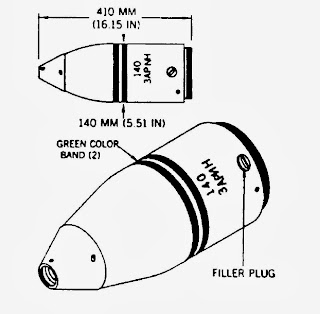
The description of this warhead in the ORDATA database:
U.S.S.R. ROCKET, WARHEAD, 140-MM, CHEMICAL, (NON-PERSISTANT), MODEL UNKNOWN
THIS ITEM CONTAINS A 2.2 KG (4.8 LB) SARIN (GB) FILLER. THE FILLER PLUG IS LOCATED JUST ABOVE THE JUNCTION OF THE WARHEAD AND ROCKET MOTOR AND HAS A BROAD WRENCH SLOT.
The warhead is gray with green markings, The markings shown are not believed to be the markings used on standard soviet chemical munitions but those used for display purposes.
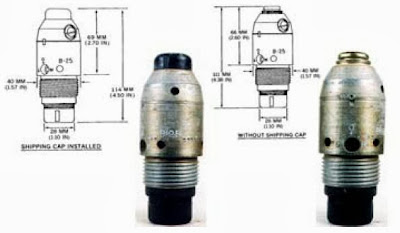
2) Two types of fuzes are associated with this chemical warhead. Both are proximity fuzes: they ignite at a preset altitude above the target.
The first fuze is unique to the 140mm rocket; the second one was used in the chemical warheads of both 140 and 240mm rockets of the former Soviet Union.
a) U.S.S.R. ROCKET FUZE, NOSE, PD, V-24
Ordnance used with:
F-961, 240 MM, SPIN STABILIZED, HE, SURFACE-TO-SURFACE
F-961U, 240 MM, SPIN STABILIZED, HE, SURFACE-TO-SURFACE
MDL UNK, WARHEAD, 140 MM, CHEMICAL, NON-PERSISTANT
MODEL UNKNOWN, 240 MM, CHEMICAL, NON-PERSISTANT
It looks like this:

b) U.S.S.R. ROCKET FUZE, NOSE, PD, V-25
Ordnance used with:
F-961, 240 MM, SPIN STABILIZED, HE, SURFACE-TO-SURFACE
F-961U, 240 MM, SPIN STABILIZED, HE, SURFACE-TO-SURFACE
M-14-OF, 140 MM, HE-FRAG
MODEL UNKNOWN, WARHEAD, 140 MM, CHEMICAL, NON-PERSISTANT
It looks like this:
(Hans de Vreij, Defensie weblog, The Netherlands, 20 September 2013)
1. The M14 140mm rocket is a vintage Soviet MLRS (Multiple Launch Rocket System, BM-14/ RPU-14). It has been succeeded by the BM-21 GRAD (122mm). Besides the 140 mm version, a 130 mm variant has also been reported. Known warheads: High Explosive (HE), smoke (WP), chemical. The latter was used to disperse Sarin (GB), a non-persistent chemical warfare agent.
During their visit to Moadamyeh (a southern suburb of Damascus), UN inspectors found an engine of the M14 rocket, but no warhead. Also, no traces of Sarin were found. The chemical warhead looks like this:

The description of this warhead in the ORDATA database:
U.S.S.R. ROCKET, WARHEAD, 140-MM, CHEMICAL, (NON-PERSISTANT), MODEL UNKNOWN
THIS ITEM CONTAINS A 2.2 KG (4.8 LB) SARIN (GB) FILLER. THE FILLER PLUG IS LOCATED JUST ABOVE THE JUNCTION OF THE WARHEAD AND ROCKET MOTOR AND HAS A BROAD WRENCH SLOT.
The warhead is gray with green markings, The markings shown are not believed to be the markings used on standard soviet chemical munitions but those used for display purposes.
The first fuze is unique to the 140mm rocket; the second one was used in the chemical warheads of both 140 and 240mm rockets of the former Soviet Union.
a) U.S.S.R. ROCKET FUZE, NOSE, PD, V-24
Ordnance used with:
F-961, 240 MM, SPIN STABILIZED, HE, SURFACE-TO-SURFACE
F-961U, 240 MM, SPIN STABILIZED, HE, SURFACE-TO-SURFACE
MDL UNK, WARHEAD, 140 MM, CHEMICAL, NON-PERSISTANT
MODEL UNKNOWN, 240 MM, CHEMICAL, NON-PERSISTANT
It looks like this:

Ordnance used with:
F-961, 240 MM, SPIN STABILIZED, HE, SURFACE-TO-SURFACE
F-961U, 240 MM, SPIN STABILIZED, HE, SURFACE-TO-SURFACE
M-14-OF, 140 MM, HE-FRAG
MODEL UNKNOWN, WARHEAD, 140 MM, CHEMICAL, NON-PERSISTANT
It looks like this:

(Hans de Vreij, Defensie weblog, The Netherlands, 20 September 2013)
zaterdag 31 augustus 2013
UN Investigation Team Returns to The Hague from Syria

The United Nations team investigating allegations of use of chemical weapons in Syria has arrived on 31 August in The Hague, the headquarters of the Organisation for the Prohibition of Chemical Weapons (OPCW), after having completed their two week deployment in Syria.
The UN investigation team, consisting of nine OPCW, three WHO experts and led by Dr Åke Sellström reached Damascus on 18 August. As per the agreement reached between the UN and the Syrian authorities, they were to conduct investigations where chemical weapons had allegedly been used, including Khan Al-Asal.
 |
| UN inspection team leader Dr Åke Sellström greeted upon his arrival at OPCW headquarters in The Hague by DG Üzümcü |
While conducting planned activities, further allegations of the use of chemical weapons emerged after an attack in the suburbs of Damascus on 21 August. The UN Secretary-General asked the team to shift its focus on to the new allegations.
On 26 August the team convoy while crossing the buffer zone between government and opposition forces, en route to Al-Moadamiya town, where chemical weapons were alleged to have been used came under attack and two of the vehicles were damaged. The team changed one of the vehicles and continued with the mission. Team members visited hospitals, interviewed doctors and suspected victims of the alleged chemical weapons attack. This team, which included six OPCW experts, returned safely to its base that evening.
The OPCW Director-General condemned the attack, and called upon all concerned parties in Syria to respect the mandate of the team and to facilitate the conduct of its work in safe conditions. This was reiterated by the UN Secretary-General, Mr Ban Ki-moon and Director-General Üzümcü when they met in The Hague on 28 August 2013.
The team continued its investigations in the suburbs of Damascus through the week of 26 August visiting allegedly affected areas. They collected both environmental and biological samples.
The evidence collected by the team will now undergo laboratory analysis and technical evaluation according to the established and recognised procedures and standards. These procedures may take up to three weeks for completion in a systematic, orderly and objective manner. Every effort will be made to expedite this process. Their report will be submitted to the United Nations Secretary General by Dr Sellström.
The Chemical Weapons Convention adhered to by 189 countries of the world represents today a global norm with zero tolerance for chemical weapons. For States that are not Parties, procedures are provided under the UN Secretary-General’s Mechanism to investigate allegations of use of chemical weapons. The present investigation in Syria is proceeding under this mechanism. The Convention and the related arrangements between the UN and the OPCW establish the basis for cooperation between the two Organisations recognising that the latter possesses the necessary expertise to investigate allegations of use.
The Director-General of the OPCW, Ambassador Ahmet Üzümcü has commended the members of the team upon on their arrival back in The Hague for their courage, professionalism and their commitment in carrying out their assigned duties in difficult and sometimes dangerous circumstances. He also thanked the German government for providing an aircraft to transport the team to The Netherlands.
(OPCW, 31 August 2013)
zaterdag 23 februari 2013
Turkish, German and Dutch defense ministers visit Patriots deployed in Turkey
Turkish Defense Minister İsmet Yılmaz along with his German and Dutch counterparts visited the Patriot missile systems deployed from both countries in Adana and Kahramanmaraş near the Turkish-Syrian border on Feb. 23.
Germany's defense minister Thomas de Maizière said during the visit that they delivered a "clear warning" to Damascus that NATO would not tolerate missiles being fired into Turkey.
"Our presence here serves to make sure that Syria doesn't turn its capabilities into action," de Maizière said, while also saying that the risk of attack was "minimal". "We can see from here that Syria is using rockets - often several times a day” he added.
German Chancellor Angela Merkel was scheduled to visit the same area on Sunday when she begins a two-day visit to Turkey.
Dutch Defense Minister Jeanine Hennis-Plasschaert reiterated that Holland was willing to fulfill its commitments as a member of NATO. “What is happening in Syria showed us that war could occur nearby in Europe. This is a very important fact [from the viewpoint of] our security concept. It is a situation that we should never forget. We have to take lessons from what we have observed in Mali, Libya and Syria,” she said.
The hosting minister Yılmaz stressed that his counterparts had come to Turkey upon the government’s invitation. He thanked both countries as well as the United States for having responded to NATO’s call, adding that deterrence has increased in the region thanks to the Patriot batteries.
Turkey requested help from its NATO allies after shells landed on its border areas from Syria in October 2012, killing a number of villagers.
NATO approved the deployment later that year in December, saying the use of ballistic missiles by the Syrian regime posed a threat to Turkey and insisting that the move to deploy Patriots was purely defensive.
(Hurriyet, 23 February 2013)
Germany's defense minister Thomas de Maizière said during the visit that they delivered a "clear warning" to Damascus that NATO would not tolerate missiles being fired into Turkey.
"Our presence here serves to make sure that Syria doesn't turn its capabilities into action," de Maizière said, while also saying that the risk of attack was "minimal". "We can see from here that Syria is using rockets - often several times a day” he added.
 |
| Defence ministers De Maizière, Hennis-Plaschaert, Yilmaz Photo: MoD, The Netherlands |
German Chancellor Angela Merkel was scheduled to visit the same area on Sunday when she begins a two-day visit to Turkey.
Dutch Defense Minister Jeanine Hennis-Plasschaert reiterated that Holland was willing to fulfill its commitments as a member of NATO. “What is happening in Syria showed us that war could occur nearby in Europe. This is a very important fact [from the viewpoint of] our security concept. It is a situation that we should never forget. We have to take lessons from what we have observed in Mali, Libya and Syria,” she said.
The hosting minister Yılmaz stressed that his counterparts had come to Turkey upon the government’s invitation. He thanked both countries as well as the United States for having responded to NATO’s call, adding that deterrence has increased in the region thanks to the Patriot batteries.
Turkey requested help from its NATO allies after shells landed on its border areas from Syria in October 2012, killing a number of villagers.
NATO approved the deployment later that year in December, saying the use of ballistic missiles by the Syrian regime posed a threat to Turkey and insisting that the move to deploy Patriots was purely defensive.
(Hurriyet, 23 February 2013)
NATO Defence Ministers visit Patriot deployment
The German, Dutch and Turkish defence ministers paid a joint visit to NATO Patriot batteries in Turkey on Saturday 23 February, in a signal of Alliance solidarity.
The Turkish defence minister Ismet Yilmaz thanked Allies for their support. ''We are very pleased at how quickly NATO responded to our request to reinforce our air defences. I personally want to thank my fellow Ministers from Germany and the Netherlands for their important contribution,'' Mr Yilmaz said.
The three defence ministers visited both the Dutch and German patriot sites at Adana and Kahramanmaras during their two-day stay, and received an operational briefing from the Dutch and German Patriot commanders. They also met with local Turkish officials and officers.
The German defence minister Thomas de Maizière stressed the defensive nature of the deployment. ''The defensive nature of the mission is not only due to the NATO mandate, but also for technical reasons. The position and range of the Patriots makes it impossible to enforce a no-fly zone or attack Syria'', said Mr de Maiziere.
The Dutch defence minister Jeannine Hennis-Plasschaert said the joint visit demonstrated the Alliance’s resolve and solidarity. ''The strong solidarity that exists in NATO is very evident here today. The Netherlands are ready and pleased to serve and help our fellow Ally Turkey,'' Ms Hennis-Plasschaert said.
The ministers travelled to Turkey immediately after attending a defence ministerial in Brussels at NATO headquarters on Friday. The visit comes after the last of the deployed batteries became operational under NATO command and control on 15 February. Germany, the Netherlands and the United States provide two batteries each to augment Turkey’s air defences. The systems are deployed in Kahramanmaras, Adana, and Gaziantep.
(NATO, 23 February 2013)
The Turkish defence minister Ismet Yilmaz thanked Allies for their support. ''We are very pleased at how quickly NATO responded to our request to reinforce our air defences. I personally want to thank my fellow Ministers from Germany and the Netherlands for their important contribution,'' Mr Yilmaz said.
 |
| Dutch Patriot launcher, Turkey. Photo: MoD, The Netherlands |
The German defence minister Thomas de Maizière stressed the defensive nature of the deployment. ''The defensive nature of the mission is not only due to the NATO mandate, but also for technical reasons. The position and range of the Patriots makes it impossible to enforce a no-fly zone or attack Syria'', said Mr de Maiziere.
The Dutch defence minister Jeannine Hennis-Plasschaert said the joint visit demonstrated the Alliance’s resolve and solidarity. ''The strong solidarity that exists in NATO is very evident here today. The Netherlands are ready and pleased to serve and help our fellow Ally Turkey,'' Ms Hennis-Plasschaert said.
The ministers travelled to Turkey immediately after attending a defence ministerial in Brussels at NATO headquarters on Friday. The visit comes after the last of the deployed batteries became operational under NATO command and control on 15 February. Germany, the Netherlands and the United States provide two batteries each to augment Turkey’s air defences. The systems are deployed in Kahramanmaras, Adana, and Gaziantep.
(NATO, 23 February 2013)
donderdag 24 januari 2013
NATO press briefing on the deployment of Patriot Missiles to Turkey
Press briefing on the deployment of Patriot Missiles to Turkey
by NATO Spokesperson Oana Lungescu and Brigadier General Gary Deakin, Director of SHAPE Strategic Operations Center
Good afternoon. Thank you very much for coming.
As you know, Patriot batteries from Germany, the Netherlands and the United States are now only days away from becoming operational in Turkey so we thought it would be timely to have a technical briefing today to explain the sequence of events that will eventually see NATO take control of these defensive batteries to help protect Turkey’s population and territory.
Let me just remind you briefly that in response to Turkey’s request, NATO Defence Ministers decided on the 4th of December last year to augment Turkey’s air defence capabilities in order to defend the population and territory of Turkey and to contribute to the de-escalation of the crisis along the Alliance’s border.
The deployment of the Patriots will be defensive only, but it sends a very strong signal of Allied solidarity.
I am very happy to introduce to you our briefer from SHAPE (Supreme Headquarters Allied Powers Europe), Brigadier Gary Deakin, who is the Director of the Strategic Operations Centre at SHAPE who will take us through this NATO effort and will explain how the batteries will be brought under NATO Command and control in the coming weeks.
The Brigadier will speak on the record, and if you have any specific technical questions on the systems, the Brigadier will explain any arrangements we have. We have got some staff officers on hand who will be able to help with answers on background after this briefing is over.
Brigadier…
Brigadier General Gary Deakin (Director of SHAPE Strategic Operations Centre): Thank you very much, Oana. Good afternoon, everybody. If I can just begin with a little bit more detail on myself. I'm obviously a British Army officer and I'm employed down in Allied Command Operations, coordinating operations at the strategic level. So when the strategic direction came from the NAC to SACEUR to deploy assets to augment Turkey air defence then the task came to my organization to make the plan.
I've got a number of experts who are with me. There are three officers in the front row here who are absolute technical experts on the detail of the systems, and so afterwards there's an opportunity... where there's a really difficult question that I can't answer, then they're ready to help out.
And my aim will be to really tell you the story as we see it right now, where we've come from and where we are at the moment, and then where we see this augmentation of Turkey's air defence going to.
And currently, it's all going according to plan which is really excellent news from our perspective.
Firstly, some context. The deployment is part of a plan that we already have. We have a standing defence plan for the air policing of NATO. And so this is not anything spectacularly new for us. The augmentation of Turkey's already robust air defence was an extra. It was within a framework of business that we already do.
We've also done this before, and indeed, The deployed to support Turkey's air defence in 1991 and 2003. So it's not... it's not new and in that way we've been able to carry out this mission quickly to provide support to the Ally as requested.
Now, we've... when the strategic direction was given to us at the beginning of December, after the Foreign Ministers meeting, SACEUR immediately set about generating the forces required and we were very fortunate to have Germany, Netherlands and the U.S. offer Patriot batteries to deploy as soon as possible to Turkey to provide this extra support. And we also stood up the NATO communications agencies to provide the CIS, the Communications Information System support to the Patriots so they could plug into the NATO Command and Control network.
So the mobilization commenced almost as soon as we got the direction. And you will have observed that the U.S. were the first to deploy assets into theatre by air, into Incirlik, which we know is the air point of disembarkation. And their initial package arrived at the beginning of January.
And then The Netherlands and Germany sailed their assets from ports in Northern Europe some two weeks ago now and as you'll be probably tracking today, they've arrived now in Iskenderun in Turkey; are unloading and unloaded and are moving out to their positions.
We expect to have an initial operating capability this weekend. That's what we're aiming at. And so it'll be confirmed at the weekend, but we're aiming for initial operating capability this weekend.
What do I mean by initial operating capability? This is where we'll have the ability... NATO will have the ability to defend some aspects of the population of what we're going to actually cover in the big picture. The first units will arrive on station. They will plug into the NATO Command and Control network and they will be then ready to defend the population. So that's what we're calling initial operating capability.
The full capability we expect to deliver... we're aiming to deliver, at the end of the month. That's our aim and that's when we'll have all the patriots in and complete. All the sustainment mechanisms in and the whole organization plugged into the NATO CIS coordinated with Turkey's air defence to provide the support... the NATO support to Turkey as requested.
And currently all that is on track.
And so The Netherlands are going to deploy to Adana. The Germans are going to deploy to Kahramanmaras—apologies for the mispronunciation—and the U.S. are going to deploy to Gaziantep. And those locations were decided in close coordination with our Turkish Allies based on the size of the population, how we could get the equipment to get the best effect. A number of factors were considered to get the best deployment options with the resources available from the nations that made the offers in this case.
So it was a very detailed process in close collaboration with our Allies to get the right lay-down of the forces that are deploying.
We estimate that once it's in place at those locations that we will provide protection against missiles for up to 3.5 million people, is our current assessment. So 3.5 million Turkish people under the protection of this missile defence capability in support of Turkey's air defence.
And I'd also emphasize again, I mentioned a couple of minutes ago about the CIS aspects. Lots of nations involved in that. There'll be NATO detatchments each location, providing the communication support, so a lot of nations involved, not just those from the contributing nations, and they'll provide that support to enable the command and control of the Patriots.
So that's where we are right now. We're just heading towards our initial operating capability, aiming to have the whole thing set up by the end of the month.
Now let me just, briefly I think, explain the capabilities of the system so you can then come back with some questions.
So a Patriot battery has got four main elements. It's a multi-function radar, which performs search identification and tracks potential targets. It's an air engagement control station and this is the only manned piece of equipment in the battery. And its responsibility is to make sure all the other systems are working and that the identification and engagement of targets is correct and in line with the procedures.
And the Patriot operators sit in this station and they're able to terminate an engagement, and control the engagement as required.
The battery then has a number of launches and this can be between four and six, depending on the mission and depending on which nation has made the contribution.
And then each missile, each launcher has a number of missiles, and again, depending on the nation, but up to 16, with a variety of different types of missiles. In this case we'll focus on destroying targets which are missiles. That is the way that this has been put together in this mission's case.
So those batteries, two in each location, as I've just described, are all connected together, so all six are together, and they're then connected directly to Air Command Ramstein in Germany. That's the operational commander, General Breedlove. And they're plugged into a Command and Control Centre there. And that Command and Control Centre is also... has situational awareness of what is happening in the region in terms of missile firings or early warning. So we're able to identify when there's some sort of missile fired that alerts the Patriot batteries, and then they can then observe the arcs that they've got in their azimuth and react accordingly if a missile is a threat to the population in that particular area that they're deployed to.
I think another point I just wish to really stress, which is really important, is the Command and Control goes to Ramstein, but there's a piece of detailed coordination into what we call the Combined Air and Operations Centre, which is in Eskisehir in Turkey. And it's there at the coordination is carried out with all the air that's going on. So to make sure that there's no risk of any accident, so that it's all very carefully controlled and coordinated.
So the air space is managed correctly. And again, this is, as I said at the beginning, this is normal business for us. There's nothing new here. We're used to this and there are procedures that are in place and it'll be correctly controlled and coordinated to make sure that there is no risk of any sort of accident.
Okay, I think that sort of covers the key points in terms of the lay down. I think hopefully I've described the... when it comes to it that the whole thing is set up and ready and we'll be ready, working very, very closely to our Turkish Allies in terms of augmenting their air defence to provide that defence to 3.5 million people. And should there be an alert on the early warning system, that will go to the Patriots and the Patriots from the nations will be ready to intercept and defend as required. And we're expecting the initial capability this weekend, that's what we're aiming at, and then we're aiming for the full capability by the end of the month.
And our current plans, and from my perspective sitting in operations, Admiral Stavridis's Operation Centre down in SHAPE, we're sort of initially planning that this will probably last for a year at least, and that's our commitment. That's what nations have said that they're prepared to commit to. Of course, there'll be decisions that may reduce that or extend it, but from our planning perspective we're planning to sustain this mission as required to augment Turkey's air defence.
If I can just clarify one really important point and that is, we're very closely integrated with the Turkish Allies in terms of the chain of command at all levels. So we have a very close relationship through each level of command, from the battery... and what I mean by that, the Patriot battery is located in an area where the Turkish military commander is going to provide him with some local support, et cetera, all the way then through to the coordination centre in the CAOC and then there are Turkish liaison officers who have gone to Air Ramstein and Air Ramstein has put liaison officers into the Turkish chain of command.
And in my own organization down in Mons, I also have liaison officers who have come from the Turkish General Staff to make sure that we've absolutely got the integration correct through all the different levels.
I think I've hopefully said enough, painted a little bit of a picture of what it looks like, where we are, and where we're going. I now stand ready to answer any questions and as I said, I've got a team to help.
Oana Lungescu (NATO Spokesperson): And as usual, please don't forget to introduce yourselves and we'll start with German Television. Just wait for the microphone Kai.
Q: I just have the question whether the whole area is now covered by the Patriots? Are there enough Patriots to cover the long borderline between Syria and Turkey? And would there... would there be the possibility to impact a No-Fly Zone if wanted with the Patriots that are at this border at the moment?
Brigadier General Gary Deakin: Okay, well, firstly the whole... Turkey's border is 900 kilometres long, so the coverage is not... will not cover the border. We're aiming at what we can with the capabilities provided, so we've got as much coverage of the population with the capabilities that nations have offered, and our assessment is that 3.5 million people in the south-western corner, southern part of Turkey over those cities and those areas that I've explained.
We don't have the capabilities to provide it extensively in the area you just described.
The capability is not being deployed at all to have anything to do with a No-Fly Zone. It's completely defensive. And it couldn't be transitioned to do so at this time. The capability is not set for that. It's not designed. The orders are not in line with that and that's what we've set out to do. It's a purely defensive mission in order to deter and hopefully deescalate and provide protection to those 3.5 million people and support our NATO Ally.
Oana Lungescu: Dutch News Agency. Over there.
Q: Sorry, it wasn't me.
Q: Hi, Robert Blumen of the Dutch Press Agency. I've got a question about initial capacity. Will there be a difference between the Dutch, German and American Patriots so that the Dutch will start, or will it be in general the initial capacity on Saturday/Sunday? You get the question?
Brigadier General Gary Deakin: Yes, yes, I understand, yes. They're very similar in terms of capacity. So the initial capability is arriving, setting up, plugging into the system, having the CIS working, being part of the whole process. That is very similar to each of the nations.
There are minor differences in terms of capabilities and going through sort of start-up procedures. But that's very, very technical and perhaps you could... you know, if you want to come back off line with the experts to clarify. But broadly it's much the same.
Q: (Inaudible...).
Brigadier General Gary Deakin: Oh no, no, no. Sorry, just to be absolutely clear. No, we currently see... I think The Netherlands will be the first to provide initial operation capability this weekend. And this is all to do with plugging in the communications technology, the site preparation, getting the sites prepared and our Turkish Allies have done a fantastic job in preparing the ground. You can imagine, you need level ground, you need shelters, you need things to put things in, and it just so happens in The Netherlands case all those things are aligning quite well. In the others it's still a little way to go to get those things completed.
Oana Lungescu: Reuters.
Q: Yes, Brigadier could you just confirm what you mean by initial operating capability? That means that the Patriot batteries, some of them, would be in place and ready to fire if necessary by this weekend, is that correct?
Brigadier General Gary Deakin: Yes. Yes, that is our aim, to have initial capability, which means we can defend with that system in place and we're aiming for this weekend. /2
by NATO Spokesperson Oana Lungescu and Brigadier General Gary Deakin, Director of SHAPE Strategic Operations Center
Good afternoon. Thank you very much for coming.
As you know, Patriot batteries from Germany, the Netherlands and the United States are now only days away from becoming operational in Turkey so we thought it would be timely to have a technical briefing today to explain the sequence of events that will eventually see NATO take control of these defensive batteries to help protect Turkey’s population and territory.
Let me just remind you briefly that in response to Turkey’s request, NATO Defence Ministers decided on the 4th of December last year to augment Turkey’s air defence capabilities in order to defend the population and territory of Turkey and to contribute to the de-escalation of the crisis along the Alliance’s border.
The deployment of the Patriots will be defensive only, but it sends a very strong signal of Allied solidarity.
I am very happy to introduce to you our briefer from SHAPE (Supreme Headquarters Allied Powers Europe), Brigadier Gary Deakin, who is the Director of the Strategic Operations Centre at SHAPE who will take us through this NATO effort and will explain how the batteries will be brought under NATO Command and control in the coming weeks.
The Brigadier will speak on the record, and if you have any specific technical questions on the systems, the Brigadier will explain any arrangements we have. We have got some staff officers on hand who will be able to help with answers on background after this briefing is over.
Brigadier…
Brigadier General Gary Deakin (Director of SHAPE Strategic Operations Centre): Thank you very much, Oana. Good afternoon, everybody. If I can just begin with a little bit more detail on myself. I'm obviously a British Army officer and I'm employed down in Allied Command Operations, coordinating operations at the strategic level. So when the strategic direction came from the NAC to SACEUR to deploy assets to augment Turkey air defence then the task came to my organization to make the plan.
I've got a number of experts who are with me. There are three officers in the front row here who are absolute technical experts on the detail of the systems, and so afterwards there's an opportunity... where there's a really difficult question that I can't answer, then they're ready to help out.
And my aim will be to really tell you the story as we see it right now, where we've come from and where we are at the moment, and then where we see this augmentation of Turkey's air defence going to.
And currently, it's all going according to plan which is really excellent news from our perspective.
Firstly, some context. The deployment is part of a plan that we already have. We have a standing defence plan for the air policing of NATO. And so this is not anything spectacularly new for us. The augmentation of Turkey's already robust air defence was an extra. It was within a framework of business that we already do.
We've also done this before, and indeed, The deployed to support Turkey's air defence in 1991 and 2003. So it's not... it's not new and in that way we've been able to carry out this mission quickly to provide support to the Ally as requested.
Now, we've... when the strategic direction was given to us at the beginning of December, after the Foreign Ministers meeting, SACEUR immediately set about generating the forces required and we were very fortunate to have Germany, Netherlands and the U.S. offer Patriot batteries to deploy as soon as possible to Turkey to provide this extra support. And we also stood up the NATO communications agencies to provide the CIS, the Communications Information System support to the Patriots so they could plug into the NATO Command and Control network.
So the mobilization commenced almost as soon as we got the direction. And you will have observed that the U.S. were the first to deploy assets into theatre by air, into Incirlik, which we know is the air point of disembarkation. And their initial package arrived at the beginning of January.
And then The Netherlands and Germany sailed their assets from ports in Northern Europe some two weeks ago now and as you'll be probably tracking today, they've arrived now in Iskenderun in Turkey; are unloading and unloaded and are moving out to their positions.
We expect to have an initial operating capability this weekend. That's what we're aiming at. And so it'll be confirmed at the weekend, but we're aiming for initial operating capability this weekend.
What do I mean by initial operating capability? This is where we'll have the ability... NATO will have the ability to defend some aspects of the population of what we're going to actually cover in the big picture. The first units will arrive on station. They will plug into the NATO Command and Control network and they will be then ready to defend the population. So that's what we're calling initial operating capability.
The full capability we expect to deliver... we're aiming to deliver, at the end of the month. That's our aim and that's when we'll have all the patriots in and complete. All the sustainment mechanisms in and the whole organization plugged into the NATO CIS coordinated with Turkey's air defence to provide the support... the NATO support to Turkey as requested.
And currently all that is on track.
And so The Netherlands are going to deploy to Adana. The Germans are going to deploy to Kahramanmaras—apologies for the mispronunciation—and the U.S. are going to deploy to Gaziantep. And those locations were decided in close coordination with our Turkish Allies based on the size of the population, how we could get the equipment to get the best effect. A number of factors were considered to get the best deployment options with the resources available from the nations that made the offers in this case.
So it was a very detailed process in close collaboration with our Allies to get the right lay-down of the forces that are deploying.
We estimate that once it's in place at those locations that we will provide protection against missiles for up to 3.5 million people, is our current assessment. So 3.5 million Turkish people under the protection of this missile defence capability in support of Turkey's air defence.
And I'd also emphasize again, I mentioned a couple of minutes ago about the CIS aspects. Lots of nations involved in that. There'll be NATO detatchments each location, providing the communication support, so a lot of nations involved, not just those from the contributing nations, and they'll provide that support to enable the command and control of the Patriots.
So that's where we are right now. We're just heading towards our initial operating capability, aiming to have the whole thing set up by the end of the month.
Now let me just, briefly I think, explain the capabilities of the system so you can then come back with some questions.
So a Patriot battery has got four main elements. It's a multi-function radar, which performs search identification and tracks potential targets. It's an air engagement control station and this is the only manned piece of equipment in the battery. And its responsibility is to make sure all the other systems are working and that the identification and engagement of targets is correct and in line with the procedures.
And the Patriot operators sit in this station and they're able to terminate an engagement, and control the engagement as required.
The battery then has a number of launches and this can be between four and six, depending on the mission and depending on which nation has made the contribution.
And then each missile, each launcher has a number of missiles, and again, depending on the nation, but up to 16, with a variety of different types of missiles. In this case we'll focus on destroying targets which are missiles. That is the way that this has been put together in this mission's case.
So those batteries, two in each location, as I've just described, are all connected together, so all six are together, and they're then connected directly to Air Command Ramstein in Germany. That's the operational commander, General Breedlove. And they're plugged into a Command and Control Centre there. And that Command and Control Centre is also... has situational awareness of what is happening in the region in terms of missile firings or early warning. So we're able to identify when there's some sort of missile fired that alerts the Patriot batteries, and then they can then observe the arcs that they've got in their azimuth and react accordingly if a missile is a threat to the population in that particular area that they're deployed to.
I think another point I just wish to really stress, which is really important, is the Command and Control goes to Ramstein, but there's a piece of detailed coordination into what we call the Combined Air and Operations Centre, which is in Eskisehir in Turkey. And it's there at the coordination is carried out with all the air that's going on. So to make sure that there's no risk of any accident, so that it's all very carefully controlled and coordinated.
So the air space is managed correctly. And again, this is, as I said at the beginning, this is normal business for us. There's nothing new here. We're used to this and there are procedures that are in place and it'll be correctly controlled and coordinated to make sure that there is no risk of any sort of accident.
Okay, I think that sort of covers the key points in terms of the lay down. I think hopefully I've described the... when it comes to it that the whole thing is set up and ready and we'll be ready, working very, very closely to our Turkish Allies in terms of augmenting their air defence to provide that defence to 3.5 million people. And should there be an alert on the early warning system, that will go to the Patriots and the Patriots from the nations will be ready to intercept and defend as required. And we're expecting the initial capability this weekend, that's what we're aiming at, and then we're aiming for the full capability by the end of the month.
And our current plans, and from my perspective sitting in operations, Admiral Stavridis's Operation Centre down in SHAPE, we're sort of initially planning that this will probably last for a year at least, and that's our commitment. That's what nations have said that they're prepared to commit to. Of course, there'll be decisions that may reduce that or extend it, but from our planning perspective we're planning to sustain this mission as required to augment Turkey's air defence.
If I can just clarify one really important point and that is, we're very closely integrated with the Turkish Allies in terms of the chain of command at all levels. So we have a very close relationship through each level of command, from the battery... and what I mean by that, the Patriot battery is located in an area where the Turkish military commander is going to provide him with some local support, et cetera, all the way then through to the coordination centre in the CAOC and then there are Turkish liaison officers who have gone to Air Ramstein and Air Ramstein has put liaison officers into the Turkish chain of command.
And in my own organization down in Mons, I also have liaison officers who have come from the Turkish General Staff to make sure that we've absolutely got the integration correct through all the different levels.
I think I've hopefully said enough, painted a little bit of a picture of what it looks like, where we are, and where we're going. I now stand ready to answer any questions and as I said, I've got a team to help.
Oana Lungescu (NATO Spokesperson): And as usual, please don't forget to introduce yourselves and we'll start with German Television. Just wait for the microphone Kai.
Q: I just have the question whether the whole area is now covered by the Patriots? Are there enough Patriots to cover the long borderline between Syria and Turkey? And would there... would there be the possibility to impact a No-Fly Zone if wanted with the Patriots that are at this border at the moment?
Brigadier General Gary Deakin: Okay, well, firstly the whole... Turkey's border is 900 kilometres long, so the coverage is not... will not cover the border. We're aiming at what we can with the capabilities provided, so we've got as much coverage of the population with the capabilities that nations have offered, and our assessment is that 3.5 million people in the south-western corner, southern part of Turkey over those cities and those areas that I've explained.
We don't have the capabilities to provide it extensively in the area you just described.
The capability is not being deployed at all to have anything to do with a No-Fly Zone. It's completely defensive. And it couldn't be transitioned to do so at this time. The capability is not set for that. It's not designed. The orders are not in line with that and that's what we've set out to do. It's a purely defensive mission in order to deter and hopefully deescalate and provide protection to those 3.5 million people and support our NATO Ally.
Oana Lungescu: Dutch News Agency. Over there.
Q: Sorry, it wasn't me.
Q: Hi, Robert Blumen of the Dutch Press Agency. I've got a question about initial capacity. Will there be a difference between the Dutch, German and American Patriots so that the Dutch will start, or will it be in general the initial capacity on Saturday/Sunday? You get the question?
Brigadier General Gary Deakin: Yes, yes, I understand, yes. They're very similar in terms of capacity. So the initial capability is arriving, setting up, plugging into the system, having the CIS working, being part of the whole process. That is very similar to each of the nations.
There are minor differences in terms of capabilities and going through sort of start-up procedures. But that's very, very technical and perhaps you could... you know, if you want to come back off line with the experts to clarify. But broadly it's much the same.
Q: (Inaudible...).
Brigadier General Gary Deakin: Oh no, no, no. Sorry, just to be absolutely clear. No, we currently see... I think The Netherlands will be the first to provide initial operation capability this weekend. And this is all to do with plugging in the communications technology, the site preparation, getting the sites prepared and our Turkish Allies have done a fantastic job in preparing the ground. You can imagine, you need level ground, you need shelters, you need things to put things in, and it just so happens in The Netherlands case all those things are aligning quite well. In the others it's still a little way to go to get those things completed.
Oana Lungescu: Reuters.
Q: Yes, Brigadier could you just confirm what you mean by initial operating capability? That means that the Patriot batteries, some of them, would be in place and ready to fire if necessary by this weekend, is that correct?
Brigadier General Gary Deakin: Yes. Yes, that is our aim, to have initial capability, which means we can defend with that system in place and we're aiming for this weekend. /2
maandag 7 januari 2013
Dutch Patriot batteries leave for Turkey
Two Dutch Patriot units left for the port of Eemshaven near Delfzijl today, to be shipped to Turkey. A total of 150 vehicles and 130 trailers will transport the missile defence materiel to the seaport. As part of Operation Anatolian Protector, the systems will protect our NATO Ally against Scud missile attacks from Syria.
The military personnel of the Defence Ground-based Air Defence Command started their 300-kilometre road journey at their home base, the Luitenant-generaal Best - Barracks in Vredepeel. The two Patriot air defence systems, including radar stations and launch installations, will move in 6 convoys of 25 vehicles and around 20 trailers each. At the port of Eemshaven, the materiel will be loaded onto a cargo ship and then travel, accompanied by 5 military personnel, to Turkey, where it is expected to arrive on 22 January.
Chief of Defence General Tom Middendorp was there to see the military personnel off. “By baring our teeth, in a military sense”, he said, “we prevent the use of even more violence. It may sound contradictory (…), but sometimes weapons are what is needed to prevent more deaths and injuries. That is exactly how the Netherlands uses its armed forces, and we have seen this for instance in our successful counterpiracy operations.”
Tomorrow, some 30 Dutch and 20 German quartermasters will leave from Eindhoven Air Base to make preparations for the mission. The main force of around 270 Dutch military personnel will follow on 21 January.
Real threat
Turkey asked NATO for assistance in protecting its population and territory from attacks by medium-range missiles from conflict hotspot Syria, its neighbour to the south. Middendorp: “The threat is a very real one. These so-called Scud missiles have a potential range of hundreds of kilometres, so they could easily hit Turkish cities.”
The Netherlands, Germany and the United States will each cover a sector, sending 2 Patriot systems each. The Dutch will be going to Adana, which with 2.1 million inhabitants is the largest city in southern Turkey.
(Ministry of Defence, The Hague, 7 January 2013)
 |
| Dutch Patriot PAC-2 launcher. Photo: MoD |
Chief of Defence General Tom Middendorp was there to see the military personnel off. “By baring our teeth, in a military sense”, he said, “we prevent the use of even more violence. It may sound contradictory (…), but sometimes weapons are what is needed to prevent more deaths and injuries. That is exactly how the Netherlands uses its armed forces, and we have seen this for instance in our successful counterpiracy operations.”
Tomorrow, some 30 Dutch and 20 German quartermasters will leave from Eindhoven Air Base to make preparations for the mission. The main force of around 270 Dutch military personnel will follow on 21 January.
Real threat
Turkey asked NATO for assistance in protecting its population and territory from attacks by medium-range missiles from conflict hotspot Syria, its neighbour to the south. Middendorp: “The threat is a very real one. These so-called Scud missiles have a potential range of hundreds of kilometres, so they could easily hit Turkish cities.”
The Netherlands, Germany and the United States will each cover a sector, sending 2 Patriot systems each. The Dutch will be going to Adana, which with 2.1 million inhabitants is the largest city in southern Turkey.
(Ministry of Defence, The Hague, 7 January 2013)
zaterdag 22 december 2012
NATO Spokesperson’s statement on the deployment of Patriot missiles to Turkey
The three NATO Allies which have agreed to provide Patriot missiles to augment Turkey’s air defences – Germany, the Netherlands and the United States - have agreed on the locations where the batteries will be deployed.
This was decided jointly with Turkey as the host nation and in close coordination with the Supreme Allied Commander Europe, following a military assessment by the Allies involved and NATO’s Military Authorities. Germany, the Netherlands and the United States have offered to provide two Patriot batteries each. Germany will deploy its batteries to Kahramanmaras, the Netherlands will deploy its batteries to Adana, and the United States will deploy its batteries to Gaziantep.
The deployment, which will take place over the next few weeks, will be defensive only. It will not support a no-fly zone or any offensive operation. Its aim is to deter any threats to Turkey, to defend Turkey’s population and territory and to de-escalate the crisis on NATO’s south-eastern border.
(NATO, 22 December 2012)
This was decided jointly with Turkey as the host nation and in close coordination with the Supreme Allied Commander Europe, following a military assessment by the Allies involved and NATO’s Military Authorities. Germany, the Netherlands and the United States have offered to provide two Patriot batteries each. Germany will deploy its batteries to Kahramanmaras, the Netherlands will deploy its batteries to Adana, and the United States will deploy its batteries to Gaziantep.
The deployment, which will take place over the next few weeks, will be defensive only. It will not support a no-fly zone or any offensive operation. Its aim is to deter any threats to Turkey, to defend Turkey’s population and territory and to de-escalate the crisis on NATO’s south-eastern border.
(NATO, 22 December 2012)
maandag 10 december 2012
Netherlands sends Patriot units to Turkey (Gov't news release)
The Cabinet has decided to send two Dutch Patriot units to Turkey to help protect the Netherlands’ NATO ally from possible attacks from Syria. The House of Representatives has been informed of the decision.
The Dutch Patriot missile defence systems will be deployed to protect Turkey’s territory and people. Their exact location will be decided in consultation with Turkey, the US and Germany. Deployment will in principle last a year, be purely defensive and not be used in support of a no-fly zone or offensive operation. No more than 360 military personnel will be posted abroad for the deployment. NATO acceded earlier this week to the Turkish government’s request for assistance.
The Netherlands, Germany and the US are the only NATO countries with Patriots that meet the required standard. The Patriot units have been deployed twice on previous occasions on NATO’s southern flank and once in Israel. During the Gulf War in 1991 Patriot systems protected the cities of Diyarbakir in Turkey and Jerusalem in Israel against possible Iraqi SCUD missile attacks. During the 2003 Gulf War the Patriots once more provided protection against possible Iraqi SCUD missile attacks for the area around the Turkish cities of Diyarbakir and Batman.
On 21 November the Turkish government submitted a request to NATO for the deployment of Patriot systems to protect Turkey’s territory and people from possible attacks from Syria. NATO’s 28 foreign ministers decided in Brussels on 4 December to strengthen the Turkish air defence capabilities within the existing NATO framework, to the extent permitted by national decision-making procedures.
The Supreme Allied Commander Europe, Turkey and the allies with Patriot systems (the Netherlands, the US and Germany) explored the feasibility and advisability of deploying them. On the basis of the outcome of these investigations, the Dutch government has decided to help honour the Turkish request. The Netherlands shares the Turkish government’s concerns, and is responding to the Turkish request as an ally in a spirit of solidarity, pursuant to the right of collective self-defence laid down in article 51 of the UN Charter. The Dutch deployment of Patriot systems is aimed at protecting the territory and people of the Netherlands’ NATO ally and helping de-escalate the crisis along the Alliance’s southern borders.
(Government.nl, 10 December 2012)
Note: This news release of the Dutch government fails to mention crucial elements contained in its Letter to Parliament of 7 December 2012 ('Kamerbrief ontplooiing van Patriot-systemen in Turkije'). First of all: the government wrote that the Netherlands and its two partners in this deployment will each protect 'an urban area' (read: city) using two Patriot batteries per city. Secondly, the Letter stresses that the Patriot units will be deployed at locations away from the Turkish-Syrian border, to the effect that: 'Het effectieve bereik van de Nederlandse Patriot-raketten is beperkt tot Turks grondgebied.' (The effective range of the Dutch Patriot missiles is limited to Turkish territory). - HdV
The Dutch Patriot missile defence systems will be deployed to protect Turkey’s territory and people. Their exact location will be decided in consultation with Turkey, the US and Germany. Deployment will in principle last a year, be purely defensive and not be used in support of a no-fly zone or offensive operation. No more than 360 military personnel will be posted abroad for the deployment. NATO acceded earlier this week to the Turkish government’s request for assistance.
The Netherlands, Germany and the US are the only NATO countries with Patriots that meet the required standard. The Patriot units have been deployed twice on previous occasions on NATO’s southern flank and once in Israel. During the Gulf War in 1991 Patriot systems protected the cities of Diyarbakir in Turkey and Jerusalem in Israel against possible Iraqi SCUD missile attacks. During the 2003 Gulf War the Patriots once more provided protection against possible Iraqi SCUD missile attacks for the area around the Turkish cities of Diyarbakir and Batman.
On 21 November the Turkish government submitted a request to NATO for the deployment of Patriot systems to protect Turkey’s territory and people from possible attacks from Syria. NATO’s 28 foreign ministers decided in Brussels on 4 December to strengthen the Turkish air defence capabilities within the existing NATO framework, to the extent permitted by national decision-making procedures.
The Supreme Allied Commander Europe, Turkey and the allies with Patriot systems (the Netherlands, the US and Germany) explored the feasibility and advisability of deploying them. On the basis of the outcome of these investigations, the Dutch government has decided to help honour the Turkish request. The Netherlands shares the Turkish government’s concerns, and is responding to the Turkish request as an ally in a spirit of solidarity, pursuant to the right of collective self-defence laid down in article 51 of the UN Charter. The Dutch deployment of Patriot systems is aimed at protecting the territory and people of the Netherlands’ NATO ally and helping de-escalate the crisis along the Alliance’s southern borders.
(Government.nl, 10 December 2012)
Note: This news release of the Dutch government fails to mention crucial elements contained in its Letter to Parliament of 7 December 2012 ('Kamerbrief ontplooiing van Patriot-systemen in Turkije'). First of all: the government wrote that the Netherlands and its two partners in this deployment will each protect 'an urban area' (read: city) using two Patriot batteries per city. Secondly, the Letter stresses that the Patriot units will be deployed at locations away from the Turkish-Syrian border, to the effect that: 'Het effectieve bereik van de Nederlandse Patriot-raketten is beperkt tot Turks grondgebied.' (The effective range of the Dutch Patriot missiles is limited to Turkish territory). - HdV
dinsdag 26 juni 2012
NAC Statement on the shooting down of a Turkish aircraft by Syria
The North Atlantic Council* (NAC) has met at Turkey's request to hold consultations within the framework of Article 4 of the Washington Treaty which states that "the Parties will consult whenever, in the opinion of any of them, the territorial integrity, political independence, or security of any of the Parties is threatened."
The North Atlantic Council discussed the shooting down of a Turkish aircraft by Syria. We consider this act to be unacceptable and condemn it in the strongest terms. It is another example of the Syrian authorities’ disregard for international norms, peace and security, and human life.
Our thoughts at this difficult time are with the missing Turkish aircrew, their families and their loved ones. We continue to follow the situation closely and with great concern, and will remain seized of developments on the South-Eastern border of NATO.
The security of the Alliance is indivisible. We stand together with Turkey in the spirit of strong solidarity.
The security of the Alliance is indivisible. We stand together with Turkey in the spirit of strong solidarity.
(NATO, 26 June 2012)
*De Noord-Atlantische Raad bestaat uit de Permanente Vertegenwoordigers (ambassadeurs) van de lidstaten te Brussel.
Abonneren op:
Posts (Atom)