 |
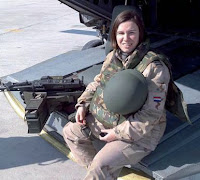
| LCOL Kleinreesink, RNLAF |
(The following excerpt is from the 2012 book '
Officier in Afghanistan' ('An Officer in Afghanistan'), written by Dutch LCOL Esmeralda Kleinreesink (RNLAF). In 2006, she was stationed at ISAF Headquarters in Kabul, as Chief Air Transport - responsible for ITAS (Intra Theatre Airlift System). In plain English: she was to provide for the air transport, so that ISAF troops could get to and from their respective bases. As a journalist, I have visited ISAF HQ and used ITAS to get from one place to another in Afghanistan.
If I were to qualify the book in one word, I'd say 'priceless'. It gives a unique insight in what it's like to work in a multinational military headquarters. And while it's light-footed (and at times outright hilarious), the underlying messages are dead serious. By the way, the incoming COMISAF referred to in the excerpt below was British General Sir David Richards, GCB, CBE, DSO, ADC. I should hasten to add that in her book, LCOL Kleinreesink has not mentioned any of the real-world characters by their full name. Likewise, encounters of the hilarious and other kinds are certainly not limited to British generals. On the contrary.
Hans de Vreij, journalist
(...)
One of the things I ponder that afternoon in Destille Garden is the new Commander’s Intent. The new British general, COMISAF, intends to spend the first two months of this command visiting all the key leaders in Afghanistan. A very commendable initiative, which might result in some logistical challenges. As a fully assimilated Italian, I therefore decide to spend my unexpected ‘afternoon off’ by inviting one of the Italian staff officers from COMISAF’s office to an espresso.
‘How many people will the new COMISAF travel with during his key leader engagement? His
aid-de-camp, some force protection people, maybe a press officer and a staff officer?’ I ask after some small talk.
‘Oh, no, he wants to travel with a large party. We are talking dozens of people.’
Apparently my face darkens, as my conversation partner asks: ‘Will that be a problem?’
‘Possibly,’ I mutter. ‘Is it true that COMISAF has his own armoured vehicle that he wants to take with him wherever he goes?’
‘Hmm,’ he says and looks around, apparently to decide whether he is willing to say more, but as Milan Palace is busy and we are surrounded by fellow Italians and Brits, he leaves it at that.
‘What are the chances that he is willing to fly without that thing?’ I ask.
‘Unlikely,’ and he gives me an intense look. I gather from this look that the new COMISAF is not only demanding when he travels, but also at the office.
‘Why do you want to know?’ he asks.
‘Because an armoured vehicle probably means that I need an additional plane.’
He nods understandingly: ‘I see your weekly remark about the shortage of planes in the reports. How many do you have? Six, seven?’
‘Try again,‘ I say.
‘Five, four…?’ he tries. I slowly shake my head and hold up two fingers. When it dawns on him what this means, he stops moving for a moment, and thinks.
‘Then how are you going to fly ITAS, the Intra Theatre Airlift System, when COMISAF is on key leader engagement?’ he asks.
Slowly I say: ‘That is exactly what I am wondering, too. I’m afraid that I’ll have to explain to COMISAF that if he wants ITAS to keep flying, he will have to travel by ground, or without his car and the entire party.’
‘I am glad you don’t ask me to deliver that message,’ he says.
The Dutch C-130 planner I carefully sound out over the telephone puts it quite plainly. No intense looks and meaningful ums, just an outspoken: ‘We offered our C-130 to NATO for ITAS, not for VIP flights. We have better use for our C-130. If this happens I’ll withdraw the Dutch offer. And I don’t think you’ll find any other country willing to make their C-130’s available for this.’ I decide to consult with my pillow on how to tell COMISAF that ITAS and key leader engagement from the air are not compatible.
The next morning, however, the colonel delivers me from this problem. For the third time in a week I stand at ease in front of a neatly cleaned desk, this time with the firm intention not to be overwhelmed again.
‘Did you tell COMISAF that he can’t fly?’
‘No, sir,’ I answer, without feeling any impulse to explain myself. If he wants to play boss-subordinate, he can get it.
‘Then why do I get to hear that?’
‘Maybe because I talked to one of COMISAF’s staff officers about his travel plans and the staff officer concluded from our little chat that it is impossible to both fly ITAS and COMISAF with this entire party,’ I say.
Flushed and emphasizing each and every word, the colonel says: ‘We are British. We do not say “no”.’
This time I am prepared. Last night I read the standard operating procedure which clearly states that the Chief Air Transport is responsible for the upkeep of ITAS and for planning the air transport capacity which has been made available to NATO. Not my department chief. I am to put the mission first and foremost, not nice COMISAF plans or national interests. Therefore I answer with the same emphasis: ‘I am NATO. It is my call. I do say “no”.’
(...)
You have read a translated excerpt from 'Officier in Afghanistan’ by Esmeralda Kleinreesink.
Interested in acquiring the foreign rights? Please contact Dutch publisher Meulenhoff via
http://www.meulenhoff.nl/nl/p4cc9c93f583e6/foreign-rights.htm
©translation and Dutch original: Esmeralda Kleinreesink, 2012


